





For technical evaluators, microencapsulation is now central to stabilizing flavors & fragrances in demanding formulations.
It reduces losses from heat, oxygen, moisture, and premature evaporation, but not every encapsulated system performs equally well.
True stability depends on wall chemistry, particle structure, release control, and process discipline.
This guide explains what improves performance, how to compare options, and where flavors & fragrances gain the most measurable value.
What does microencapsulation actually improve in flavors & fragrances?
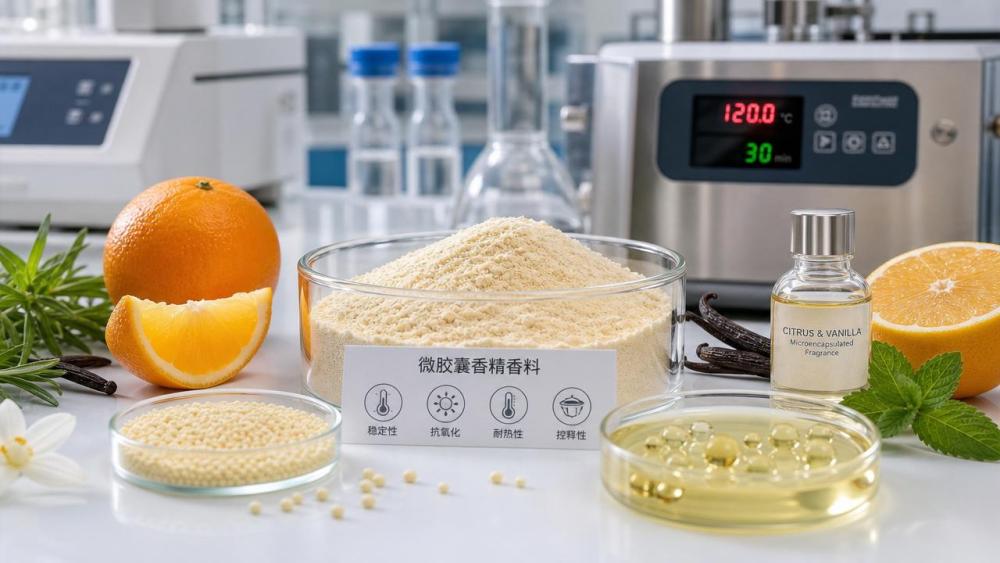
Microencapsulation surrounds volatile or reactive aroma compounds with a protective wall.
That barrier delays contact with oxygen, water, light, and other ingredients that degrade sensory quality.
In flavors & fragrances, stability means more than keeping material inside a particle.
It also means preserving top notes, reducing off-odor formation, and ensuring release happens at the right moment.
For food systems, encapsulation can protect citrus oils, vanilla notes, mint actives, and heat-sensitive flavor blends.
For fragrance systems, it can improve storage tolerance, substrate deposition, and delayed scent bloom.
The main benefits usually include:
- Lower volatilization during storage and transport
- Better oxidation resistance for sensitive actives
- Improved heat tolerance during drying, baking, or processing
- Reduced interaction with acids, salts, or surfactants
- More controlled release in use
However, encapsulation can also mute sensory impact if release is too slow.
That is why technical success must balance protection and availability.
Which wall materials most influence stability?
Wall material choice is usually the first predictor of performance in flavors & fragrances.
Different shells control oxygen transfer, water sensitivity, mechanical strength, and release triggers.
Common options include carbohydrates, proteins, gums, lipids, and polymeric systems.
Maltodextrin is popular because it sprays well and supports cost-efficient powders.
Yet alone, it may offer limited aroma retention for highly volatile fractions.
Gum arabic often improves emulsion stability and volatile protection.
Modified starches can help with film formation and process robustness.
Proteins can provide excellent interfacial properties, but pH and allergen considerations matter.
Lipid-based carriers may perform better where moisture protection is critical.
A practical evaluation should check:
- Compatibility with target aroma chemistry
- Barrier strength against oxygen and humidity
- Processing temperature tolerance
- Regulatory and label acceptance
- Release behavior in the final application
In clean label applications, wall material simplicity can be as important as technical performance.
The best flavors & fragrances systems often use blends, not single materials.
How do particle size, morphology, and process conditions affect results?
Encapsulation quality is shaped by structure as much as chemistry.
Particles with cracks, surface oil, or uneven wall thickness usually lose actives faster.
For flavors & fragrances, exposed oil on particle surfaces is a major warning sign.
It accelerates oxidation and causes early aroma loss during storage.
Smaller particles may disperse better, but they also offer more surface area.
Larger particles may protect better, though they can affect texture or appearance.
Process selection matters too.
Spray drying is efficient and widely used, especially in food flavors & fragrances.
Coacervation can support stronger capsules and more targeted release.
Fluidized bed coating can add layered protection after particle formation.
Freeze drying may preserve sensitive compounds, but economics can limit use.
During evaluation, focus on these indicators:
- Encapsulation efficiency
- Surface oil percentage
- Particle size distribution
- Moisture content and water activity
- Flowability and caking behavior
These data points reveal whether stability comes from real structure or from optimistic specification language.
Why does release behavior matter as much as protection?
A stable capsule is not useful if it releases too little aroma when needed.
In flavors & fragrances, performance always depends on timing.
A beverage powder may need fast release in water.
A baked product may need thermal survival first, then flavor bloom during consumption.
A fabric care fragrance may need friction-triggered release after drying and storage.
Release can be triggered by heat, moisture, pressure, pH, enzymes, or dissolution.
The wrong trigger creates a mismatch between formulation and user experience.
Useful screening questions include:
- When should the aroma be noticed?
- What environmental condition activates release?
- Will the matrix suppress diffusion?
- Does the shell leave residue or dullness?
For this reason, sensory testing and analytical testing should run together.
Headspace analysis alone cannot fully predict perceived fragrance or flavor intensity.
Where are the biggest risks and common mistakes in evaluating encapsulated systems?
One common mistake is assuming all volatility problems need stronger encapsulation.
Sometimes the core issue is poor emulsion design, incompatible carriers, or weak packaging barriers.
Another mistake is judging flavors & fragrances only by fresh production samples.
A system may smell excellent at day one and fail after humidity cycling or thermal stress.
A third mistake is overlooking interaction with the final matrix.
Acids, salts, alcohols, surfactants, and fats can all change stability or release.
Watch for these risk signals:
- High surface oil despite strong retention claims
- Poor flowability or visible caking under humidity
- Sensory dullness compared with non-encapsulated controls
- Rapid aroma drop after package opening
- Unclear release trigger documentation
Reliable evaluation should include accelerated stability, real-time storage, application simulation, and sensory confirmation.
How should cost, shelf life, and application fit be compared?
The best option is rarely the cheapest powder per kilogram.
For flavors & fragrances, value comes from retained impact at the moment of use.
A higher-cost encapsulated system may reduce dosage, waste, returns, and inconsistency.
Comparison should therefore be functional, not only nominal.
Good decisions compare delivered aroma performance per finished product, not ingredient price alone.
That principle is especially relevant in cross-category flavors & fragrances development.
What is a practical framework for selecting better microencapsulated flavors & fragrances?
A simple framework can reduce trial time and avoid specification-driven errors.
Start with the failure mode first.
Is the main threat oxidation, heat, humidity, migration, or early evaporation?
Then match shell type and process to that failure mode.
After that, confirm release behavior in the real matrix.
A useful sequence is:
- Define stability risk and target shelf life
- Screen wall materials for compatibility
- Review surface oil, moisture, and retention data
- Test process survival in the real formulation
- Validate sensory release at use conditions
- Compare delivered cost and compliance fit
For intelligence-led evaluation, this structured view helps connect chemistry, sensory performance, and commercial practicality.
That is where FFAI adds value across food, home care, and beauty-linked flavors & fragrances analysis.
Microencapsulation improves stability only when protection, structure, and release work together.
The strongest flavors & fragrances solutions are application-specific, data-backed, and verified under realistic conditions.
Use a framework that checks wall materials, particle quality, trigger design, and shelf-life evidence before drawing conclusions.
For deeper formulation intelligence, benchmark encapsulated systems against real use scenarios and measurable sensory outcomes.
Related News
- How to Choose Fragrance Ingredients for Diffusers That Stay Stable in Oil BasesAug 04, 2026Aromatics & Perfumery Fellow
- How to Choose Aroma Ingredients for Candles Based on Scent Throw and Wax CompatibilityAug 03, 2026Aromatics & Perfumery Fellow
- Home Diffuser Series Technical Guide for Fragrance BuyersJul 21, 2026Aromatics & Perfumery Fellow
- EU Bans More Microencapsulated Fragrance AllergensJul 16, 2026Aromatics & Perfumery Fellow
Related News
- 00
0000-00
2026 Osong Cosmetics and Beauty Expo Concludes in South Korea - 00
0000-00
How to compare cosmetic active compounds by their cost in use - 00
0000-00
HKBU Showcases DR2 Following NMPA Registration as a New Cosmetic Ingredient - 00
0000-00
How to use ingredient market insights to forecast sourcing costs - 00
0000-00
Galderma Marks 30 Years of Hyaluronic Acid Injectable Innovation
Aromatics & Perfumery Fellow
Weekly Insights
Stay ahead with our curated technology reports delivered every Monday.