





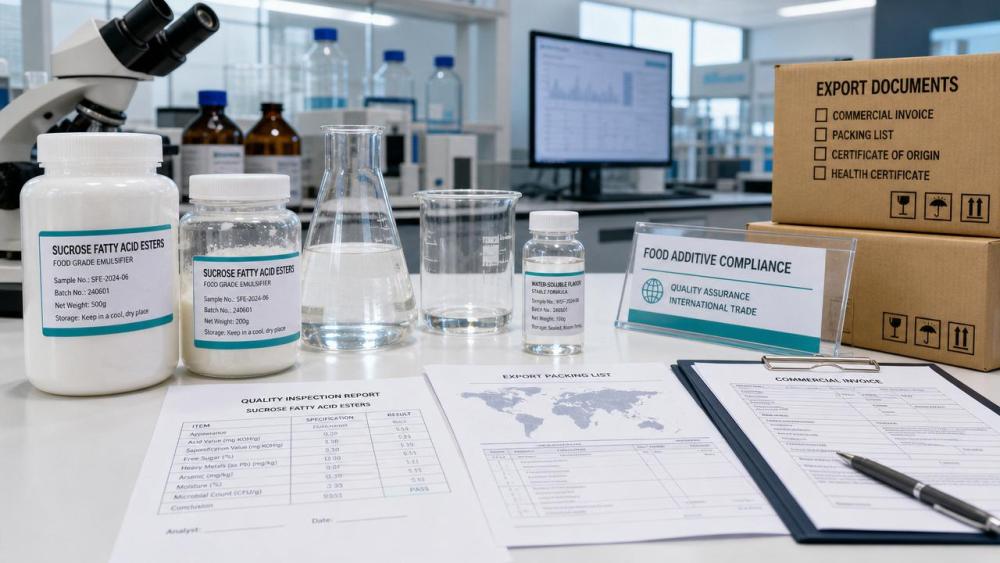
The timing of the underlying event is not clearly specified in the source input, but the policy signal is clear: on May 11, 2026, the China Food Additives and Ingredients Association opened public consultation on a revised GB 1886.240 for sucrose fatty acid esters. The draft points to possible changes in purity indicators, heavy metal limits, microbial control requirements, and an added appendix for water-soluble flavor stabilization use. This matters not only to additive manufacturers, but also to buyers, exporters, import compliance teams, and supply-chain partners that rely on sucrose esters as an emulsifying and stabilizing carrier within Water-soluble Flavors.
What the draft revision explicitly covers
Confirmed information shows that the China Food Additives and Ingredients Association released a public consultation on May 11, 2026 for a new version of GB 1886.240 covering food additive sucrose fatty acid esters.
The draft is described as proposing revisions to purity indicators, heavy metal limits, and microbial control requirements. It also adds an appendix stating applicability to water-soluble flavor stabilization applications.
The summary further confirms that this standard directly affects the technical parameters and compliance boundary for sucrose esters when used as an emulsifying and stabilizing carrier in Water-soluble Flavors. It also indicates that importers in Europe and the United States need to update supplier audit checklists accordingly.
Where the compliance impact is likely to appear first
Specification management around additive supply
From an industry perspective, additive producers and raw material suppliers may be affected first because the draft touches core specification items: purity, heavy metals, and microbial control. These are not marginal wording changes; they shape how product specifications, internal quality criteria, and supporting technical documents are prepared and reviewed.
For companies supplying sucrose esters into flavor-related applications, the practical focus is likely to be whether existing technical files and certificates still align with the draft direction, especially where the product is positioned for water-soluble flavor stabilization.
Procurement and supplier approval in cross-border trade
Buyers, importers, and sourcing teams may see the main impact in supplier qualification and audit processes. The summary already signals that European and U.S. importers need to revise supplier audit checklists, which means procurement review may move beyond price and delivery toward tighter document verification linked to composition, contaminant limits, and microbiological control.
In practice, what deserves closer attention is whether purchasing specifications, supplier questionnaires, and contract attachments clearly reflect the intended application boundary for sucrose esters used in Water-soluble Flavors.
Testing and evidence at the point of delivery
Processors, exporters, and service providers involved in shipment release or quality review may also be affected because any revision to purity, heavy metal, or microbial requirements can alter which test reports, declarations, or technical evidence are expected during delivery and acceptance.
Analysis shows that even before formal implementation details are known, companies involved in order fulfillment should pay attention to whether current documentation sets are sufficient to support compliance claims under the revised draft language.
What companies should watch during the consultation phase
Review the alignment of product dossiers
Companies handling sucrose esters should compare existing product specifications, technical data sheets, and quality statements against the areas named in the draft summary. This is particularly relevant where the material is sold or purchased for water-soluble flavor stabilization rather than for a broader, less clearly defined use case.
Prepare for checklist changes in supplier audits
Observably, the most immediate operational change may come through supplier review rather than through instant market enforcement. Importers and procurement teams should therefore be ready to adjust audit templates, supplier questionnaires, and supporting document requests in line with the revised standard scope described in the consultation summary.
Track how application language is interpreted
The added appendix on applicability to water-soluble flavor stabilization deserves close attention because application wording often shapes compliance boundaries in real transactions. Companies should watch for how this language is reflected later in official wording, customer technical requirements, and commercial documentation.
Watch downstream document requests and tender wording
Where sales involve export review, customer qualification, or technical bidding, businesses should monitor whether buyers begin requesting updated test reports, revised declarations, or more detailed statements on use conditions for Water-soluble Flavors. The current input does not provide final execution details, so this remains a point for follow-up rather than a settled requirement.
Why this looks more like a rule signal than a finished rule
Analysis shows that this development is better understood as a meaningful regulatory and market signal rather than a fully settled compliance outcome. The consultation itself confirms direction: tighter or revised attention to purity, heavy metals, microbiological control, and application scope for sucrose fatty acid esters.
At the same time, the available information does not establish final implementation language, enforcement timing, or a complete execution pathway. For that reason, the market relevance is already visible, but the final compliance burden still depends on how the consultation evolves and how purchasers, auditors, and downstream users translate it into operating requirements.
How the market should read this update now
The current draft should be read as an early but concrete signal that the compliance framework for sucrose esters in Water-soluble Flavors is being defined more precisely. Its importance lies less in headline value and more in the likely effect on technical specifications, supplier approval logic, and cross-border compliance review.
It is more appropriate to understand this as a developing rule change that already deserves internal review, especially for companies exposed to export trade, imported ingredient approval, and flavor-system sourcing. Final market impact still requires observation of subsequent wording, execution practice, and industry feedback.
Basis of this article and points still requiring verification
This article is generated from the user-provided news title, event timing field, and event summary. The specific official source link was not provided in the input, so the underlying announcement and any later formal documents still need continued verification.
For this type of development, relevant source categories usually include official notices, regulator publications, industry association releases, standard-setting documents, customs or trade authority information, and reporting by authoritative trade media. Further observation is still needed on final policy wording, certification and audit interpretation, tender document changes, market feedback, and how companies implement the new requirements in practice.
Related News
- When heat stable flavor formulations are needed for UHT beveragesOct 04, 2026Aromatics & Perfumery Fellow
- How heat stable flavor formulations prevent aroma loss in baked goodsOct 03, 2026Aromatics & Perfumery Fellow
- Using 4-vinyl guaiacol flavour standard to calibrate sensory panelsOct 02, 2026Aromatics & Perfumery Fellow
- Garlic Powder Flavor Profiles and Their Role in Seasoning BlendsSep 28, 2026Aromatics & Perfumery Fellow
Related News
- 00
0000-00
2026 Osong Cosmetics and Beauty Expo Concludes in South Korea - 00
0000-00
How to compare cosmetic active compounds by their cost in use - 00
0000-00
HKBU Showcases DR2 Following NMPA Registration as a New Cosmetic Ingredient - 00
0000-00
How to use ingredient market insights to forecast sourcing costs - 00
0000-00
Galderma Marks 30 Years of Hyaluronic Acid Injectable Innovation
Aromatics & Perfumery Fellow
Weekly Insights
Stay ahead with our curated technology reports delivered every Monday.