





On August 7, 2026, the European Food Safety Authority (EFSA) issued an amendment to Regulation (EU) 2026/1193, further tightening testing requirements for herbicide residues related to natural food colorants. The limits of detection for indicators such as glyphosate and acetamiprid were lowered to 0.005 mg/kg, with mandatory implementation clearly set for October 1, 2026. This change directly affects customs clearance, CPNP notification, and the preparation of importer compliance documents for natural food colorants exported from China, especially categories such as gardenia yellow, monascus red, and sodium copper chlorophyllin. Relevant enterprises should therefore review their existing testing, documentation, and delivery arrangements as soon as possible.
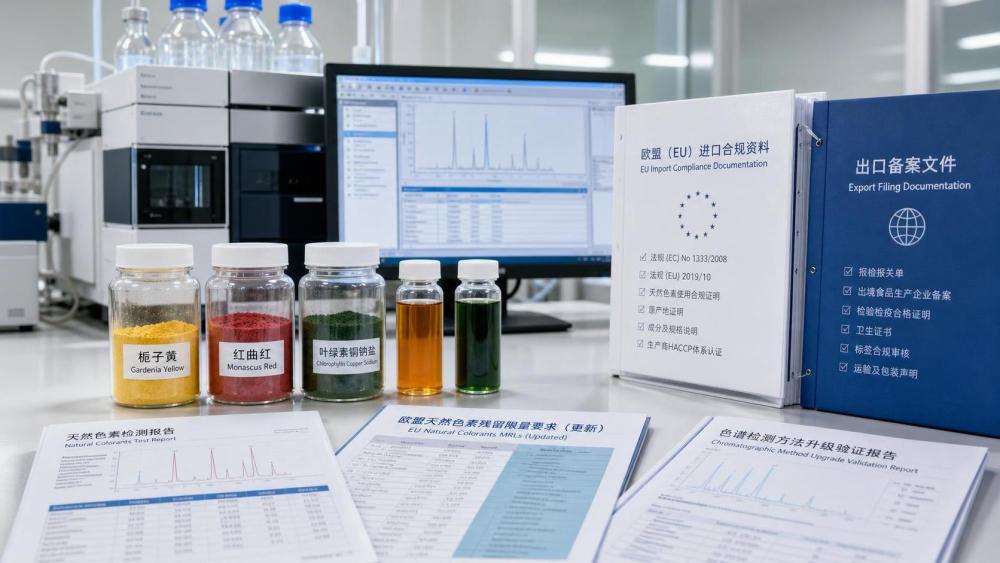
Tighter Detection Limits Raise Requirements for Customs Clearance and Notification
According to confirmed information, EFSA’s latest release is an amendment to Regulation (EU) 2026/1193. The core change is that the detection limit for herbicide residues in natural food colorants has been lowered to 0.005 mg/kg, with mandatory enforcement beginning on October 1, 2026. The event summary also clearly states that this revision will affect customs clearance and CPNP notification procedures for natural food colorants exported from China to the EU market. Importers will need to resubmit declarations of conformity and third-party LC-MS/MS validation reports.
Based on the information itself, this is not a general technical adjustment, but a regulatory change that directly affects customs clearance and notification materials. For the foreign trade chain, compliance certificates are no longer merely accompanying documents shipped with the goods. They will become part of advance verification before order placement, shipment, and import notification.
Every Part of the Supply Chain Must Recheck Document Consistency
Exporters Will First Feel the Impact on Shipment Schedules
Enterprises directly exporting natural food colorants must first address whether their customs clearance materials are consistent with the new limits. If existing test reports, declarations of conformity, or technical documents are still prepared under the previous requirements, the goods may face requests for resubmission or supplementary proof during import notification and release. For enterprises, the impact will mainly concentrate on order confirmation, shipment scheduling, and document review.
Procurement and Processing Must Review Raw Material Controls
For raw material procurement enterprises and processing manufacturers, the new detection limits mean that procurement acceptance and batch release can no longer rely only on routine indicators. Companies must trace back to upstream raw material sources, production process controls, and retained-sample testing. This is especially important for categories identified as potentially affected, such as gardenia yellow, monascus red, and sodium copper chlorophyllin. Procurement contracts, incoming material specifications, and internal inspection items all need to be reviewed accordingly.
Testing Bodies and Certification Services Face Document Updates
For third-party testing service providers and certification-related companies, the key tasks will involve updating LC-MS/MS validation reports, declarations of conformity, and the supporting data cited in those documents. The issue is not simply adding another report, but confirming whether the report conclusions, method applicability, and sample batches can support importers in completing renewed notification under the new rules.
Trade and Supply Chain Services Must Watch Delivery Risks Closely
For traders, supply chain service providers, and distribution channels, the direct impact of the regulatory change is increased delivery uncertainty. If the importing side requires supplementary documents, logistics timing, port arrival arrangements, and customer receiving plans may all be passively adjusted. Therefore, document circulation and responsibility boundaries need to be clarified in advance.
What Enterprises Should Review First Around the October 1 Deadline
For enterprises at the current stage, the most practical step is not to wait for market feedback, but to complete internal compliance reviews around the clearly defined mandatory implementation date. This includes rechecking whether exported products fall within the affected categories, confirming whether testing limits have been updated to 0.005 mg/kg, and reviewing whether existing declarations of conformity and third-party test reports can be directly used for import notification.
For enterprises with European orders, it is also important to pay attention to whether importers have received new material requirements. The change specifically mentions the need to resubmit declarations of conformity and third-party LC-MS/MS validation reports. If any part of the document chain fails to match the new requirements, delivery schedules and customer acceptance are usually the first areas to come under pressure.
From a procurement management perspective, supplier qualification review should also be moved forward. Rather than handling supplementary documents after shipment, it is better to confirm testing capabilities, batch controls, and document output methods before placing orders, so as to avoid pushing compliance risks downstream to the port and notification stages.
This Looks More Like an Execution Signal Than a Matter Still Under Discussion
From an analytical perspective, this information is better understood as a regulatory change that has already sent a clear execution signal, rather than a development still at the discussion stage. The reason is that the event summary has already provided the amendment name, the detection limit value, and the mandatory implementation date, while also specifying the direct impact on customs clearance and CPNP notification.
However, caution is still needed. For different products, importers, and testing institutions, whether the implementation approach will be further detailed in subsequent documents remains worth continued attention. What the industry currently needs to focus on is not drawing final conclusions about the change itself, but monitoring whether official statements, notification material requirements, and references to testing methods continue to be updated.
The Next Priority Is Whether the Document Chain Can Align With the New Requirements
Overall, the significance of this update for natural food colorant exporters mainly lies in the tightening of the compliance pathway. Testing, declarations, notification, and customs clearance are no longer separate steps, but must be recalibrated under the same set of rules. At present, it is more appropriate to understand this as a regulatory change that has entered the countdown to implementation. Enterprises should prioritize checking whether their documents, testing, and supply chain support can complete the transition before October 1.
Public Information Used for This Article
This article has been prepared based on the information title, event date, and event summary provided by the user. Source types typically relevant to this kind of event include official announcements, regulatory releases, customs or trade authority information, industry association updates, standards organization documents, and reporting from authoritative media. Since the input did not provide specific official source links, this article cannot verify the full text of the original document. Follow-up attention should continue to be paid to policy details, certification implementation approaches, changes in tender documents, industry feedback, and actual corporate execution.
Related News
- How natural food pigments for bakery hold color during bakingSep 20, 2026Food Rheology Expert
- EFSA Tightens MRLs for Natural Food ColorsAug 10, 2026Food Rheology Expert
- EFSA Updates Residue Limits for Natural Colorants, Drawing Attention to China’s Export Compliance PathwaysAug 08, 2026Food Rheology Expert
- EFSA Tightens Herbicide Residue Limits for Natural ColorsAug 04, 2026Food Rheology Expert
Related News
- 00
0000-00
How ingredient intelligence platforms improve market research decisions - 00
0000-00
How scientific anti-aging skincare targets wrinkles at the cellular level - 00
0000-00
Garlic Powder Storage: Managing Moisture to Protect Aroma and Flow - 00
0000-00
How to select aroma chemical ingredients for better fragrance stability - 00
0000-00
How natural food pigments for bakery hold color during baking
Food Rheology Expert
Weekly Insights
Stay ahead with our curated technology reports delivered every Monday.