





Yes—xanthan gum can replace some synthetic thickeners in skincare, but it is rarely a drop-in replacement. In a lotion or opaque serum, it may provide enough body and low-shear structure to meet the product brief. In a crystal-clear gel or a cream designed for a short, silky break during spreading, the same substitution can create haze, stringiness, or a noticeably different after-feel.
The practical problem usually appears when a reformulation keeps the original formula and simply exchanges one polymer for another. A batch may look thick enough in the vessel yet dispense poorly, feel tacky, or lose stability during storage. The better approach is to identify what the original thickener actually does, then determine whether xanthan can reproduce those functions alone or needs a supporting ingredient.
Start with the original thickener’s job, not its ingredient category
“Synthetic thickener” covers materials with substantially different behavior. Carbomers, acrylates copolymers, and associative polymers do not all build viscosity in the same way. Some form transparent gels after neutralization; others interact with surfactants or dispersed oil droplets. Certain commercial blends also contribute emulsification or arrive with carriers that affect processing and texture.
Xanthan gum is a fermentation-derived polysaccharide used primarily to modify the aqueous phase. It produces shear-thinning behavior: the product becomes easier to move during pumping, rubbing, or dispensing, then develops more resistance to flow when those forces decrease. This can support suspension and slow the movement of droplets in an emulsion.
However, thickening the water phase is not the same as emulsifying oil and water. Xanthan generally does not replace the interfacial function of an emulsifier. Removing a multifunctional polymer blend and adding xanthan may therefore remove more than viscosity.
Before changing the formula, record the original ingredient’s exact identity, supplied concentration, carrier system, recommended processing conditions, and stated functions. Compare active polymer content rather than assuming equal percentages of two commercial ingredients represent equal amounts of thickener.
Where a full replacement is most plausible
The strongest candidates are products that tolerate some opacity and do not depend on an exceptionally clean gel break. An opaque hydrating serum, a fluid lotion, or a rinse-off mask may accommodate xanthan more readily than a transparent gel serum. Existing emulsifiers and fatty structuring ingredients can also reduce how much work the replacement polymer must perform.
An electrolyte-containing serum can be worth screening because xanthan often tolerates salts better than some conventional carbomer systems. That does not establish universal compatibility. Salt identity, concentration, pH, and other ingredients still influence performance, and salt-tolerant synthetic polymers may remain better suited to the sensory target.
Products requiring high transparency, minimal residue, or a sharply defined gel texture deserve early sensory screening. There is little value in completing an extensive stability program for a prototype that already fails the intended user experience.
Compare flow and skin feel—not just a viscosity reading
Two formulas can show similar viscosity at one instrument setting and behave differently in use. One may pour cleanly while the other stretches into threads. A pump may deliver an acceptable dose from both, yet one leaves more residue around the nozzle. These differences reflect the structure and deformation behavior of the formulation, not simply its thickness.
Use the original product as a reference and examine several practical behaviors:
- At rest: does the formula resist settling, creaming, or running off the application area?
- During dispensing: does it pump, squeeze, or pour without excessive force, sputtering, or stringing?
- During spreading: does it thin smoothly, or develop drag and a gummy film?
- After application: does it leave tack, visible residue, or pilling when layered with the intended routine?
Where rheology equipment is available, compare behavior across relevant shear rates and assess structural recovery after shear. Keep temperature, sample age, and preparation consistent. A single spindle reading remains useful for routine control, but it cannot independently establish sensory equivalence or suspension performance.
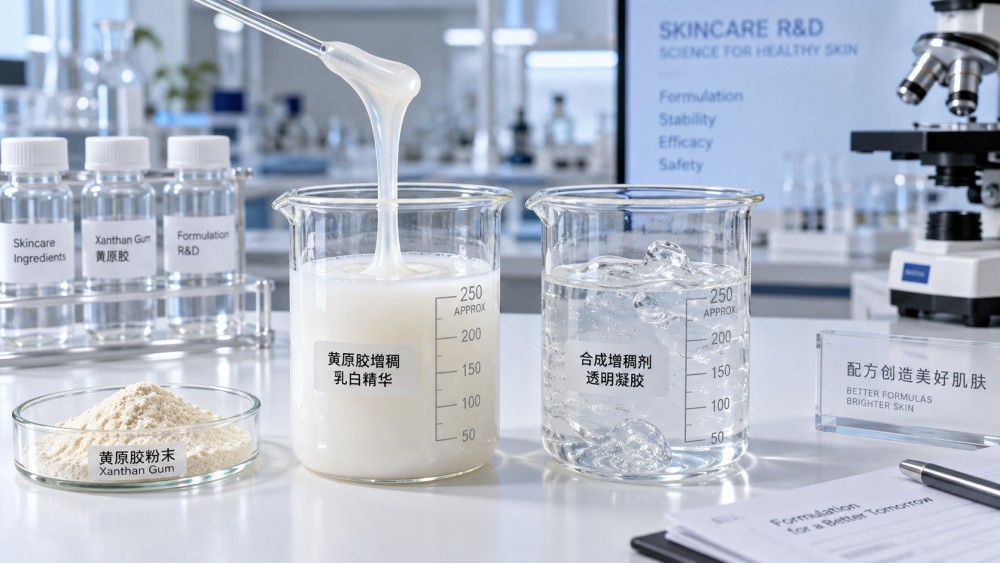
Xanthan grade selection matters here. Grades can differ in clarity, hydration characteristics, and texture. A supplier’s “clear” or “low-stringiness” description is a screening aid, not evidence that the finished formula will meet its specification.
Build the substitution trial in a controlled sequence
1. Define what must stay unchanged
Set acceptance criteria before making prototypes. These might include appearance, pH, dispensing behavior, spreadability, suspension, and package compatibility. Separate essential requirements from characteristics that can change. A natural-origin reformulation may allow a slightly different texture, but it should not quietly sacrifice stability or dose delivery.
Retain the original formula as a control. Prepare an additional version without the original thickener when practical; this helps reveal how much structure comes from emulsifiers, fatty alcohols, or other ingredients rather than the polymer alone.
2. Screen a small concentration ladder
Do not begin with a weight-for-weight exchange. Select several xanthan levels using the supplier’s cosmetic application guidance and the target product type. Low tenths of a percent can be a useful screening region for some aqueous products and emulsions, but the appropriate level depends on the grade and formula.
Keep the other ingredients constant during the first screen and adjust water to maintain the total formula. Compare samples only after sufficient hydration and equilibration. Raising xanthan repeatedly to chase one viscosity number can produce an increasingly gummy product without restoring the original texture.
3. Establish a reliable dispersion method
Dry xanthan can form clumps when its outer surface hydrates before water reaches the interior. These “fish eyes” may resemble insoluble particles and leave part of the gum unavailable for thickening.
One practical route is to pre-disperse the powder in a compatible portion of glycerin or another suitable nonaqueous wetting medium already present in the formula, then add that dispersion to water under controlled mixing. Alternatively, add powder gradually into an effective vortex using a supplier-recommended method. A pre-dispersion wets and separates particles; it does not replace hydration in water.
Allow adequate hydration time and inspect for remaining agglomerates. Excessive aeration can interfere with appearance and viscosity measurements, so record mixing speed, addition rate, temperature, and hold time rather than relying on “mix until thick.”
4. Add challenging ingredients deliberately
Where the process permits, establish hydration before adding substantial electrolyte loads or ingredients likely to interfere with dispersion. Introduce actives, salts, surfactants, and pH adjusters in a controlled sequence and observe any change after each addition.
Xanthan does not generally require the neutralization step used by conventional carbomers to develop viscosity. Nevertheless, the final pH still matters for the complete formula, including preservative performance, active stability, and skin compatibility. Do not automatically remove or retain the old neutralizer without reviewing its remaining purpose.
Read the failure before changing the formula again
The batch looks thin but contains gel-like specks. Check dispersion and hydration first. Increasing the gum may worsen clumping while leaving the continuous phase under-thickened. Examine the addition method and compare a properly hydrated gum solution with the finished batch.
The lotion separates despite being thick. Investigate the emulsifier system, droplet formation, and processing temperature. High aqueous-phase viscosity can slow separation without preventing coalescence. If the removed ingredient supplied emulsification, that function needs a replacement rather than simply more xanthan.
The product strings between fingers or leaves tack. Reduce the xanthan level and evaluate another grade before increasing humectants or adding unrelated sensory modifiers. Tack can also arise from the humectant and film-former package, so compare against the control instead of attributing every change to the gum.
A clear serum becomes hazy. Check gum grade, incomplete hydration, trapped air, and compatibility with the rest of the formula. Do not promise transparency based on the appearance of a gum solution in water; the complete ingredient mixture determines the final result.
Viscosity changes after adding an active. Record the active’s carrier, electrolyte contribution, and pH effect. Cationic ingredients deserve particular attention because xanthan is anionic and interactions can cause changes in appearance or rheology. Compatibility must be demonstrated in the actual formulation.
When a blend is more defensible than complete replacement
Partial substitution can preserve useful low-shear structure while limiting the sensory penalties of a higher xanthan concentration. A lower level of synthetic polymer combined with xanthan may outperform either ingredient alone against the product brief. This is a legitimate formulation outcome, even when it does not support a “synthetic-thickener-free” claim.
A formulation pursuing that claim may instead need a compatible natural-origin co-thickener or a revised emulsion structure. Such changes require separate screening: polymer blends can behave nonlinearly, and adding another gum does not automatically eliminate stringiness. Some cellulose derivatives are chemically modified, so their suitability for a particular ingredient policy should not be assumed.
Define the claim requirement before optimizing the texture. “Fermentation-derived,” “natural-origin,” and “unmodified natural” are not interchangeable descriptions. Obtain appropriate ingredient documentation and assess the finished-product wording under the applicable market rules or chosen certification criteria. Origin alone does not establish that a thickener is safer, gentler, or more effective.
Approve the finished formula, not the substitution concept
Promising bench texture is only the first gate. Evaluate the candidate against the control through a stability program suited to its intended storage, transport, packaging, and shelf life. Track appearance, pH, viscosity using a defined method, separation, and dispensing. Temperature cycling, freeze–thaw exposure, or centrifugation can be useful screens where relevant, but none independently proves shelf-life stability.
Repeat preservation efficacy assessment when the reformulation could affect preservation; a changed polymer system, process, or raw-material microbial profile can alter the finished product’s behavior. Xanthan is neither a preservative nor a substitute for hygienic manufacturing. Use a grade with suitable cosmetic specifications and documentation.
Finally, confirm the process at a representative scale. Changes in powder addition, mixing geometry, hydration time, and air incorporation can turn a successful laboratory prototype into an inconsistent production batch. Approve full replacement only when the formula meets the required stability, sensory, and packaging criteria. If those criteria are met only by a blend, partial replacement is the technically supported choice—not an incomplete version of success.
Related News
- How to assess a bio-based thickener manufacturer's batch consistencyOct 16, 2026Food Rheology Expert
- Verifying halal status of hydrocolloid ingredients in the Middle EastOct 15, 2026Food Rheology Expert
- Why Can Xanthan Gum Lose Viscosity After Adding Electrolytes?Oct 18, 2026Food Rheology Expert
- How Do You Test Hydrocolloid Viscosity After Changing a Thickener?Oct 17, 2026Food Rheology Expert
Related News
- 00
0000-00
BASF to Debut Anti-Aging and Amino Acid Innovations at in-cosmetics Asia 2026 - 00
0000-00
How to vet global ingredient solution providers using references - 00
0000-00
Sihuan Pharmaceutical’s Two Self-Developed Aesthetic Products Approved in Hong Kong - 00
0000-00
How to identify turning points in FMCG ingredient price trends - 00
0000-00
KANS Unveils “365 Cyclic Peptide” System for Technology-Based Anti-Aging
Food Rheology Expert
Weekly Insights
Stay ahead with our curated technology reports delivered every Monday.