





Food Thickeners Wholesale: Cost, MOQ, and Quality Checks
For procurement teams evaluating food thickeners wholesale options, price alone is never enough. From MOQ flexibility and supply stability to viscosity performance, purity, and compliance, every detail affects product quality and margin. This guide breaks down the key cost drivers, quality checks, and sourcing benchmarks buyers should review before choosing a reliable wholesale thickener supplier.
If you have bought hydrocolloids before, you already know the trap: two suppliers quote the same thickener name, one looks cheaper on paper, and six weeks later your production team is chasing viscosity drift, dusty powder handling, or documentation gaps for export. In food thickeners wholesale, the invoice price is only one line in the real cost.
Buyers usually start with xanthan gum, carrageenan, guar gum, pectin, CMC, modified starches, agar, or locust bean gum. The exact product changes by application, but the buying logic is surprisingly consistent: check whether the material performs in your process, whether the supplier can keep it consistent, and whether the commercial terms still make sense when demand moves.
Start with the use case, not the catalog
A common sourcing mistake is buying by ingredient name only. “Xanthan gum” is not enough. The same applies to pectin or carrageenan. You need to define what the thickener is supposed to do in your formula and process.
- Is the target function thickening, suspension, stabilization, gel formation, water binding, or texture correction?
- Will it run in acidic beverages, dairy, bakery filling, sauces, meat systems, or plant-based applications?
- Does the product face high shear, UHT, freezing and thawing, or hot filling?
- Is clean label a must, or are modified systems acceptable in the destination market?
Without those answers, price comparison is weak. A lower-cost gum that fails in low pH or salts can become the most expensive option in the room.
What really moves cost in food thickeners wholesale
Procurement teams often ask for a “best wholesale price,” but suppliers are pricing several hidden variables at once. Understanding them helps you negotiate better and compare quotes more fairly.
- Grade and specification. Finer mesh, tighter viscosity windows, lower microbial limits, or application-specific grades usually cost more.
- Origin and raw material seasonality. Guar and locust bean gum can be affected by harvest conditions and crop availability. That changes pricing faster than many buyers expect.
- Purity and standardization. Higher assay or more consistent rheology typically means stricter process control.
- Packaging format. Bulk bags, 25 kg multiwall bags, liner requirements, pallet configuration, and moisture protection all affect landed cost.
- Documentation burden. Export markets asking for allergen statements, non-GMO declarations, halal, kosher, or application support create real administrative cost.
- Lead time commitment. Spot buying and emergency production slots are rarely priced the same as scheduled annual contracts.
A practical move: ask every supplier to quote against the same basis. Same incoterm, same annual volume estimate, same pack size, same target specification, same destination market. Otherwise you are not comparing wholesale offers. You are comparing assumptions.
MOQ is not just a commercial number
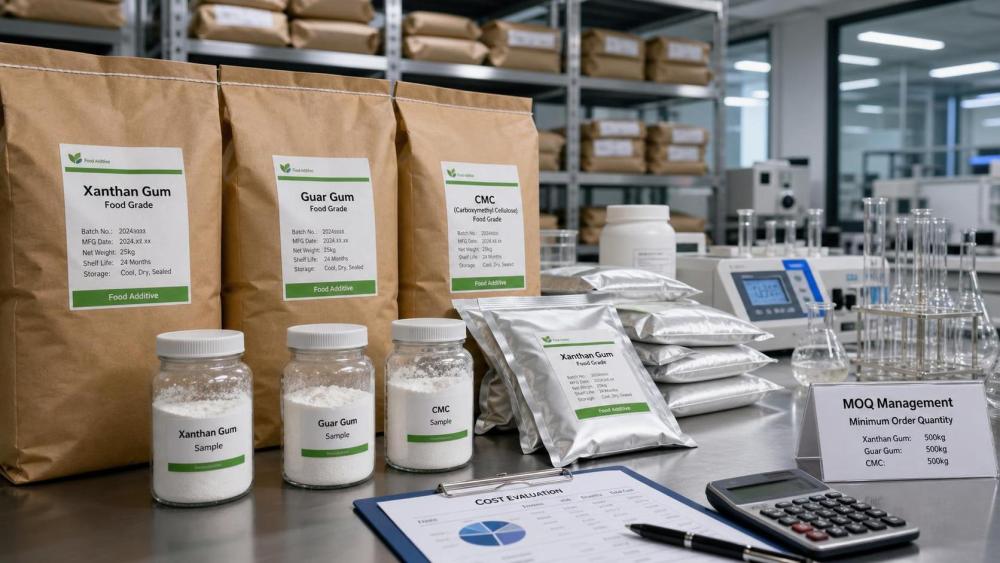
Minimum order quantity tells you a lot about supplier fit. For a buyer, MOQ affects working capital, warehouse pressure, trial speed, and supply risk.
If your usage is stable and high, a larger MOQ may be acceptable in exchange for better pricing and reserved capacity. If you are launching a new SKU or validating a reformulation, a rigid MOQ can create dead stock before you even know the formula is right.
Ask these questions early:
- What is the MOQ for samples, trial lots, and full commercial orders?
- Can mixed pallet or mixed container shipments be accepted?
- Is there a surcharge for lower-than-standard order volume?
- Can the supplier hold stock under a forecast agreement?
- What is the shelf life remaining at shipment, not only total shelf life?
That last point matters more than buyers sometimes admit. A good price on a 24-month shelf life item is less attractive if only 16 months remain when it reaches your warehouse and your consumption cycle is slow.
Quality checks that deserve more than a COA glance
A Certificate of Analysis is necessary, but it is not the whole quality review. Buyers in food thickeners wholesale should read both the product specification and the test method reference. “Viscosity: pass” tells you very little if the method, concentration, temperature, and instrument conditions are missing.
Here is the short list worth checking before approval:
One experienced buyer habit: compare three recent batch COAs, not just one. You are checking consistency, not just compliance on a good day.
Run an application trial before locking the supplier
This sounds obvious, yet it gets skipped under timeline pressure. A thickener that passes a lab spec can still fail in your system. Hydration speed, clumping tendency, shear response, synergy with proteins or starches, and mouthfeel are application questions, not paperwork questions.
For buyer-side trials, keep the protocol simple and repeatable. Test the current approved supplier against the new one at the same dosage. Record dispersion behavior, time to full hydration, final viscosity, pH impact where relevant, heat stability, and sensory outcome. If you have a plant trial option, use it before committing annual volume. Lab success alone can hide scaling problems.
If the supplier offers a lower dosage claim, request supporting application data and verify internally. Sometimes the dosage reduction is real. Sometimes it depends on a formulation environment that does not match yours.
Compliance paperwork should match the market you sell into
Procurement often inherits this late, usually from QA, regulatory, or customs. It is better to bring it forward.
At minimum, ask for the specification sheet, COA template, SDS where applicable, allergen statement, country of origin, storage conditions, shelf life, and relevant food compliance declarations for your destination market. Exact regulatory acceptance depends on product type and country, so avoid assumptions and verify with your internal regulatory team.
Claims such as non-GMO, organic, halal, kosher, or clean label positioning should be checked against actual certificates or controlled declarations. If a supplier uses vague language like “can support export documents,” treat that as incomplete until the documents are reviewed.
For buyers serving multiple regions, keep a market checklist. A thickener approved for one route to market may still create label or documentation friction elsewhere. Details vary, and some points may be market-specific【待核实】 unless confirmed against current regulations.
Supply stability is where cheap quotes often break down
When buyers change suppliers to save a few points on raw material cost, the real risk is not only quality. It is continuity. Food thickener supply can tighten because of crop conditions, shipping disruption, plant maintenance, or sudden demand shifts in processed food segments.
Ask direct questions:
- Is the supplier a manufacturer, distributor, or trader?
- Do they have a second manufacturing site or backup source?
- What is the standard lead time, and how often does it slip?
- Can they show recent supply performance data【待核实】 or at least shipment history by lane?
- Do they keep safety stock for strategic accounts?
None of this needs to become a long audit if your volume is small. But if the ingredient is critical to your texture system and hard to replace mid-run, single-source dependency deserves attention.
Watch the total landed cost, not the bag price
This is where many purchasing decisions become clearer. A lower ex-works number can still lose once freight, duties, customs handling, storage loss, trial failures, and higher use levels are included.
Three examples that change the math quickly:
- The product is cheaper per kilogram, but needs higher dosage to hit the same texture.
- The supplier has a high MOQ, so inventory carrying cost wipes out the price benefit.
- The material disperses poorly, increasing production time or creating reject batches.
For procurement reviews, convert supplier offers into cost-in-use wherever possible. That gives operations and finance something more realistic than a simple unit price ranking.
A short supplier approval checklist that actually helps
- Approved application fit confirmed by lab or plant trial
- Specification and COA reviewed, including test methods
- Recent batch consistency checked
- MOQ, lead time, and remaining shelf life aligned with your inventory model
- Commercial quote normalized by the same incoterm and pack basis
- Regulatory and market-entry documents reviewed by QA or regulatory team
- Packaging and storage suitability confirmed for your warehouse conditions
- Escalation contact and complaint handling process established
That list is not glamorous, but it catches most of the expensive surprises.
The best food thickeners wholesale decision is usually not the one with the lowest first quote. It is the one that stays consistent in production, clears documentation without drama, and fits your demand pattern without trapping cash in stock. If a supplier can support those three things, the sourcing conversation becomes much easier to defend internally.
Related News
- How to assess a bio-based thickener manufacturer's batch consistencyOct 16, 2026Food Rheology Expert
- Verifying halal status of hydrocolloid ingredients in the Middle EastOct 15, 2026Food Rheology Expert
- Why Can Xanthan Gum Lose Viscosity After Adding Electrolytes?Oct 18, 2026Food Rheology Expert
- How Do You Test Hydrocolloid Viscosity After Changing a Thickener?Oct 17, 2026Food Rheology Expert
Related News
- 00
0000-00
2026 Osong Cosmetics and Beauty Expo Concludes in South Korea - 00
0000-00
How to compare cosmetic active compounds by their cost in use - 00
0000-00
HKBU Showcases DR2 Following NMPA Registration as a New Cosmetic Ingredient - 00
0000-00
How to use ingredient market insights to forecast sourcing costs - 00
0000-00
Galderma Marks 30 Years of Hyaluronic Acid Injectable Innovation
Food Rheology Expert
Weekly Insights
Stay ahead with our curated technology reports delivered every Monday.