





For sourcing decisions, washing surfactants are no longer judged by price per kilogram alone.
Real value depends on cleaning power, dosage efficiency, foam behavior, biodegradability, supply stability, and regulatory confidence.
As detergent, shampoo, and institutional cleaning formulas face cost pressure, washing surfactants must deliver measurable performance in practical use.
Washing Surfactants and the Cost Performance Balance
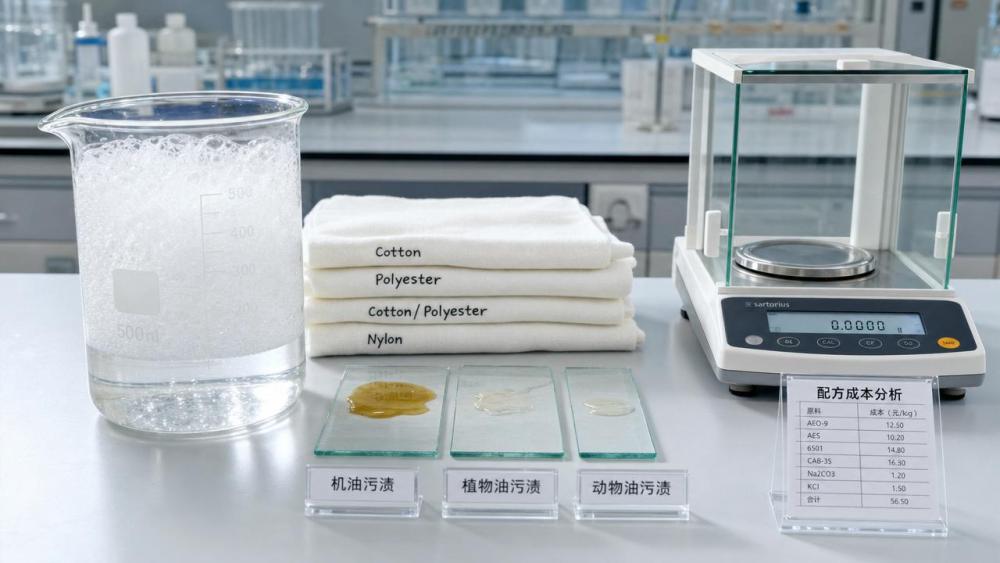
Washing surfactants are surface-active molecules that reduce tension between water, oil, soil, fibers, skin, or hard surfaces.
Their structure usually contains a hydrophilic head and a lipophilic tail, enabling micelle formation in water.
These micelles surround grease and particulate soil, helping rinse them away during washing, shampooing, or surface cleaning.
The cheapest material may not be the lowest-cost option when dosage, rewash rate, fragrance retention, and consumer perception are considered.
A higher-priced surfactant can reduce total formula cost if it cleans effectively at lower active levels.
This is why washing surfactants should be compared through active matter cost, not only delivered material cost.
Core Technical Families
- Anionic surfactants offer strong detergency, good foam, and attractive economics.
- Nonionic surfactants improve grease removal, cold-water cleaning, and hard-water tolerance.
- Amphoteric surfactants balance mildness, foam stability, and compatibility in personal care.
- Cationic surfactants support fabric softness, antimicrobial positioning, or conditioning effects.
Most commercial systems use blends because single washing surfactants rarely satisfy cost, foam, mildness, and cleaning targets together.
Industry Signals Shaping Surfactant Selection
The global FMCG sector is moving toward concentrated formats, transparent labels, lower-temperature washing, and milder personal cleansing products.
These trends change how washing surfactants are evaluated across laundry, dishwashing, shampoo, body wash, and professional cleaning.
FFAI tracks ingredient intelligence across food, fragrance, cosmetics, and cleaning chemistry with a molecular and compliance-focused perspective.
In washing surfactants, the same intelligence logic applies: performance must connect with safety, sensory quality, and supply resilience.
Cost pressure is real, but underperforming washing surfactants can create hidden losses through complaints, returns, and brand erosion.
A technically sound benchmark therefore includes cleaning score, active dosage, foam profile, viscosity impact, and supplier reliability.
How Cost Should Be Compared in Formulas
The first cost layer is active matter price, because commercial washing surfactants are often supplied as aqueous solutions or pastes.
A 70% active material at a higher delivered price may be cheaper than a dilute alternative per active kilogram.
The second layer is use level, because stronger washing surfactants can reduce total inclusion rate in finished formulas.
The third layer is system efficiency, where builders, enzymes, solvents, polymers, and fragrances interact with surfactant behavior.
Cost Factors Beyond Unit Price
- Active matter percentage and water content.
- Cleaning performance at target dosage.
- Compatibility with enzymes, preservatives, pigments, and fragrances.
- Salt response, viscosity curve, and processing energy.
- Foam generation, foam stability, and rinse speed.
- Packaging impact from concentration and viscosity.
- Supply volatility, lead time, and minimum order quantity.
For liquid laundry detergents, excessive foam can reduce machine efficiency, even if cleaning performance looks strong in lab jars.
For shampoos, mildness and sensory foam may justify more expensive washing surfactants with better skin and scalp compatibility.
For institutional cleaners, low-foam nonionic surfactants may outperform cheaper high-foam systems during spray, CIP, or machine cleaning.
Cleaning Performance Metrics That Matter
Cleaning performance is not one number. It depends on soil type, fabric, water hardness, temperature, mechanics, and contact time.
Washing surfactants that remove sebum well may not remove clay soil or pigment particles equally well.
A robust evaluation should use representative soils from real consumer and professional environments.
The most useful comparison tests washing surfactants at equal active matter and at equal finished formula cost.
This separates true surfactant efficiency from effects caused by simply adding more material.
It also reveals whether premium ingredients create real savings, sensory upgrades, or only marketing-friendly label changes.
Application Scenarios and Typical Surfactant Choices
Different cleaning categories require different washing surfactants because soil load, substrate sensitivity, and consumer expectations vary sharply.
A laundry concentrate values stain removal, storage stability, enzyme compatibility, and cost per wash.
A shampoo values mildness, foam creaminess, viscosity, fragrance release, and after-feel.
Natural-origin positioning can influence selection, but washing surfactants still need verified cleaning results.
A plant-derived claim cannot compensate for poor stability, weak grease removal, or difficult viscosity control.
Compliance, Safety, and Sustainability Considerations
Regulatory expectations vary by region and product category, especially for cosmetics, household detergents, and professional-use cleaners.
Documentation should include safety data sheets, impurity profiles, allergen considerations, biodegradation data, and regional inventory status.
For export formulas, washing surfactants must align with labeling rules, restricted substances, and local notification requirements.
FFAI’s compliance lens highlights the practical risk of selecting ingredients without sufficient technical and regulatory traceability.
Sustainability Checks
- Review ready biodegradability and aquatic toxicity data.
- Confirm renewable carbon claims with supplier evidence.
- Assess palm-derived inputs and certification expectations.
- Check concentration benefits for transport and packaging reduction.
- Verify that greener washing surfactants still meet performance targets.
Sustainability is strongest when it reduces environmental load without increasing dosage or rewash frequency.
A biodegradable surfactant used inefficiently may create higher total consumption across the product life cycle.
Practical Evaluation Framework for Better Decisions
A disciplined evaluation framework prevents washing surfactants from being selected through price quotes alone.
The process should connect laboratory evidence, pilot stability, processing behavior, consumer experience, and commercial availability.
- Define target soils, substrates, water hardness, temperature, and wash cycle.
- Compare washing surfactants at equal active matter and equal formula cost.
- Measure detergency, foam, rinse time, viscosity, clarity, and odor impact.
- Test compatibility with enzymes, preservatives, fragrances, dyes, and thickeners.
- Run accelerated stability at heat, cold, freeze-thaw, and warehouse conditions.
- Review compliance files, origin claims, impurity limits, and supply capacity.
- Calculate cost per use, not only cost per kilogram.
The strongest option is often a balanced blend rather than the most powerful individual surfactant.
Blends allow formulators to tune micelle structure, foam, mildness, viscosity, and grease removal with better economic control.
This approach also reduces dependence on a single raw material during supply disruptions.
Common Trade-Offs in Cost and Cleaning Power
Anionic washing surfactants often provide excellent cost efficiency, but they may require balancing agents for mildness.
Nonionic materials can improve oily soil removal, yet some may depress foam or affect clarity in certain systems.
Amphoteric surfactants improve foam stability and mildness, but they are usually not the lowest-cost primary cleaners.
Amino acid surfactants can support premium positioning, though their economics depend on dosage, sensory value, and claim strategy.
The best washing surfactants strategy is therefore evidence-based, category-specific, and linked to finished-product economics.
Action Steps for Sourcing and Formula Review
Start by mapping current washing surfactants against performance gaps, complaint patterns, regulatory exposure, and cost per finished use.
Then request comparable technical data from suppliers, including active matter, impurities, biodegradation, origin, and regional compliance status.
Pilot at realistic production conditions, because viscosity, aeration, fragrance bloom, and filling behavior can change at scale.
Finally, keep a dual-source plan for critical washing surfactants where supply interruption would threaten production continuity.
FFAI supports ingredient decisions by connecting molecular function, compliance intelligence, sensory expectations, and market pricing logic.
For future formula reviews, prioritize washing surfactants that deliver verified cleaning, controlled cost, safer compliance, and credible sustainability.
Related News
- How biodegradable surfactants for laundry affect cold-water cleaningSep 15, 2026Surfactant Chemistry Architect
- EU REACH Restriction Tightens Rules for Detergent ActivesJul 15, 2026Surfactant Chemistry Architect
- Surfactant Technology Guide: Performance, Cost, and Formulation Trade-OffsJun 20, 2026Surfactant Chemistry Architect
- How Washing Surfactants Affect Cleaning Power and ResidueJun 08, 2026Surfactant Chemistry Architect
Related News
- 00
0000-00
Bairun Nine-Month Profit Up 20.4% to RMB 662m; Flavors and Fragrances Also Grow - 00
0000-00
How biomimetic peptides work in anti-aging skincare formulations - 00
0000-00
2026 Osong Cosmetics and Beauty Expo Concludes in South Korea - 00
0000-00
How to compare cosmetic active compounds by their cost in use - 00
0000-00
HKBU Showcases DR2 Following NMPA Registration as a New Cosmetic Ingredient
Surfactant Chemistry Architect
Weekly Insights
Stay ahead with our curated technology reports delivered every Monday.