





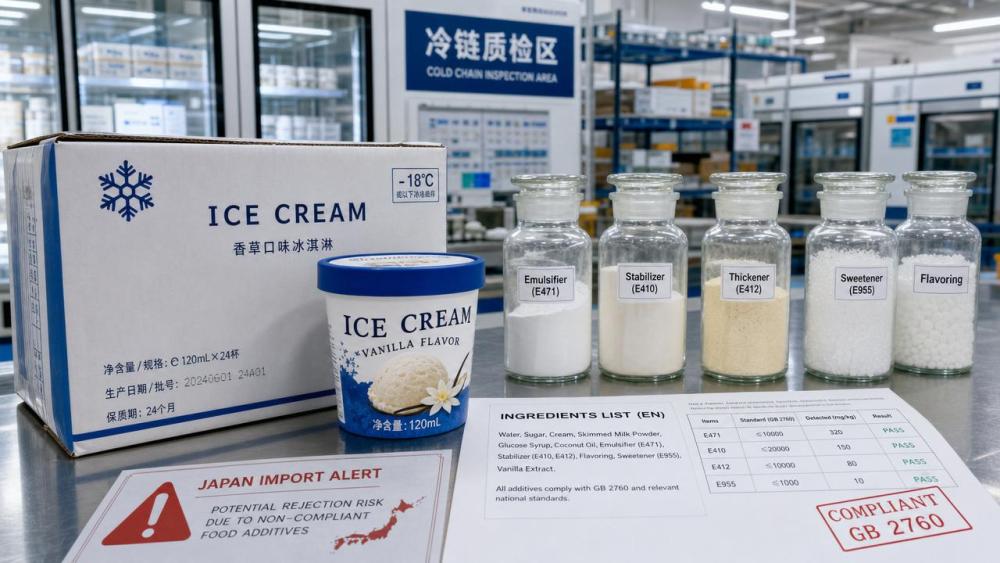
On June 4, 2026, Japan’s Ministry of Health, Labour and Welfare reported that one batch of ice cream exported from China was rejected after the detection of an unauthorized natural preservation-related substance, including excessive sodium dehydroacetate and an undeclared plant-based anti-browning agent. For the food export chain, this is not just a single shipment issue. It highlights a practical compliance gap between the exporting country standard, GB 2760-2024, and the importing country framework, the Japan JFSL Annex, and brings closer scrutiny to formulation review, ingredient declaration, import documentation, and delivery risk for suppliers involved in water-soluble preservative systems, Blended Freshness Agents, and Natural Antioxidants.
What has been formally reported so far
The confirmed information available is limited and clear. Japan’s Ministry of Health, Labour and Welfare issued a notification on June 4, 2026 concerning one batch of ice cream produced in China. The batch was refused entry because it contained an unauthorized natural freshness-preserving component, specifically excess sodium dehydroacetate and an undeclared plant-derived anti-browning agent.
The event directly points to a technical difference between the food additive standard applied in the exporting market, GB 2760-2024, and the import-side requirements referenced as the Japan JFSL Annex. Based on the provided summary, the affected compliance path is particularly relevant to suppliers and exporters connected to water-soluble preservative systems, Blended Freshness Agents, and Natural Antioxidants.
Why the compliance gap matters across the supply chain
For exporters, formula legality becomes a destination-market issue
Analysis shows that exporters of finished frozen foods cannot rely only on domestic formulation compliance when shipping into a foreign market. Where ingredient use conditions, authorization scope, or declaration requirements differ between GB 2760-2024 and the Japan JFSL Annex, the export review process may shift from a routine quality check to a market-specific admissibility assessment. The main impact is likely to appear in pre-shipment formulation screening, export documentation preparation, and customs clearance risk control.
For ingredient suppliers, “natural” positioning does not remove regulatory exposure
From an industry perspective, suppliers of water-soluble preservative systems, Blended Freshness Agents, and Natural Antioxidants may face closer customer questions on whether an ingredient is permitted, how it must be declared, and whether the blend composition is fully transparent for the destination market. The issue here is not only ingredient performance, but whether the compliance route for compound or plant-derived components can withstand import review.
For manufacturers, declaration accuracy affects production and release decisions
Observably, processing manufacturers using composite freshness-preserving solutions may need to pay closer attention to the gap between internal recipes, supplier technical materials, and export labels or declarations. If an ingredient is present but not properly declared, or if use levels exceed the import market’s allowance, the risk extends beyond one shipment to production release approval, batch traceability, and downstream order fulfillment.
For buyers and supply chain service providers, delivery certainty may become harder to assess
Analysis shows that importers, traders, and logistics-linked service providers may need tighter document review before shipment booking or receipt planning. Where additive authorization and declaration standards diverge, procurement and delivery schedules may be affected by additional verification steps, reformulation requests, or replacement sourcing. In practice, this can influence supplier qualification review, order timing, and acceptance conditions.
What companies should review now
Recheck destination-market authorization before export release
What deserves closer attention is whether ingredients that are acceptable under GB 2760-2024 are also authorized in the destination market under the Japan JFSL Annex, and under what conditions. This should be treated as a product-by-product and ingredient-by-ingredient review point rather than a general assumption based on domestic compliance.
Compare technical files with actual declarations
Analysis shows that companies should closely compare formulation records, supplier specifications, and export declaration materials, especially where plant-derived functional ingredients or blended preservation systems are involved. The present case indicates that undeclared components can become a direct import review trigger, even where the formulation may have been developed for freshness or quality control purposes.
Pay attention to blended systems and compound ingredient transparency
For companies using blended freshness solutions, current attention should focus on whether all sub-components are visible in technical documents and whether their intended use aligns with import-side rules. This is particularly relevant where a commercial blend is marketed by function rather than by full regulatory composition disclosure.
Prepare for possible changes in lead time and document review depth
Observably, companies involved in export orders to Japan may need to allow more time for compliance confirmation, document verification, and internal sign-off. The provided information does not establish a broader enforcement outcome, but it does suggest that additive-related scrutiny can affect shipment readiness, customer communication, and post-shipment traceability expectations.
How this signal should be read at this stage
From an industry perspective, this development is more appropriate to understand as an execution-level compliance signal rather than proof of a fully expanded new rule regime. The reported rejection does not by itself confirm a universal policy shift, but it clearly shows that technical differences between domestic and import-market additive rules are being operationalized in border review.
Analysis shows that the most important point is not the single rejected batch alone, but the fact that “natural” preservation-related ingredients are not exempt from detailed admissibility and declaration scrutiny. Companies should therefore continue to watch how official language, compliance interpretation, customer specification requirements, and market practice evolve after this notification.
A practical reading for the frozen food export market
This case matters because it narrows the margin for treating additive compliance as a purely domestic standard issue. For exporters of ice cream and for suppliers tied to preservation and antioxidant systems, the immediate takeaway is the need for tighter alignment between formula design, ingredient disclosure, and destination-market rules. At present, it is more appropriate to read this event as a concrete import control signal tied to regulatory differences, while the wider market response and any further execution trends still require observation.
Basis of this article and points that still need verification
This article is generated based on the user-provided news title, event date, and event summary. For events of this type, commonly relevant source categories may include official notices, releases from regulatory authorities, customs or trade administration information, industry association updates, standard-setting documents, and reporting by authoritative media. No specific official source link was provided in the input, so further verification remains necessary.
Observably, the points that still need continued attention include any subsequent official clarification, changes in compliance interpretation, updates in certification or document review practice, procurement specification adjustments, tender document wording, market feedback, and how affected companies implement ingredient review and export control procedures in response.
Related News
- Flavour preservation failures caused by oxygen exposure in beveragesOct 01, 2026Food Preservation Scientist
- Which flavour preservation method best protects citrus top notes?Sep 30, 2026Food Preservation Scientist
- How functional additives for beverages affect shelf-life stabilitySep 11, 2026Food Preservation Scientist
- Ingredient selection for preservatives when pH limits antimicrobial efficacySep 07, 2026Food Preservation Scientist
Related News
- 00
0000-00
2026 Osong Cosmetics and Beauty Expo Concludes in South Korea - 00
0000-00
How to compare cosmetic active compounds by their cost in use - 00
0000-00
HKBU Showcases DR2 Following NMPA Registration as a New Cosmetic Ingredient - 00
0000-00
How to use ingredient market insights to forecast sourcing costs - 00
0000-00
Galderma Marks 30 Years of Hyaluronic Acid Injectable Innovation
Food Preservation Scientist
Weekly Insights
Stay ahead with our curated technology reports delivered every Monday.