





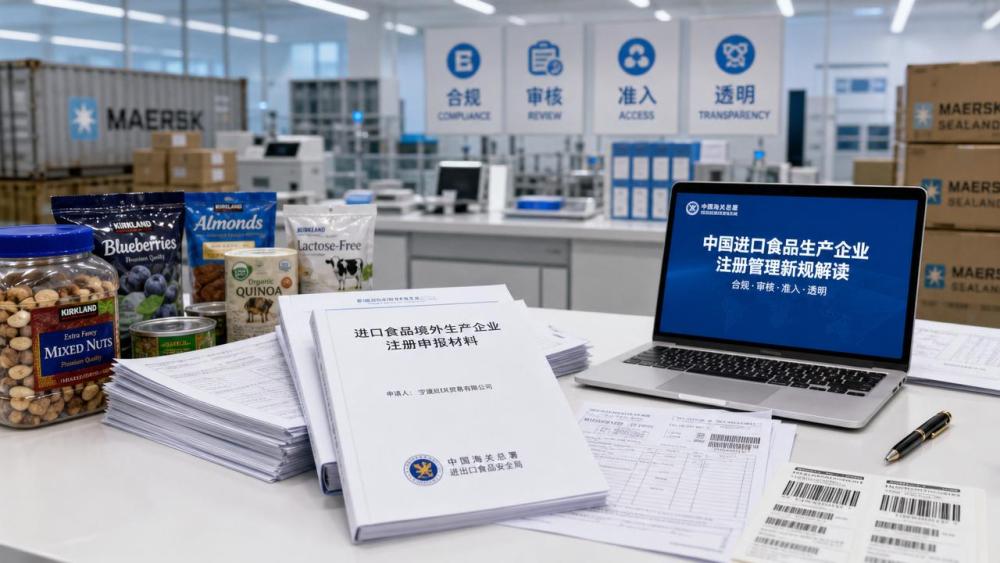
On June 1, 2026, China formally put into effect the new rules for registering overseas food manufacturers under General Administration of Customs Order No. 280. The update introduces risk-based classification, automatic renewal of registration validity for most categories except meat products and bird’s nest, intelligent assisted review, and list-based batch registration. For exporters, ingredient suppliers, processors, and compliance teams serving China-bound trade, the change is worth close attention because it directly affects registration timing, documentation pathways, and market access planning across a large base of registered food enterprises.
What the new framework puts in place
The Regulation on the Registration and Administration of Overseas Producers of Imported Food took effect on June 1, 2026 under General Administration of Customs Order No. 280. According to the provided information, the rule introduces four confirmed changes: risk-based classification management, automatic extension of registration validity excluding meat products and bird’s nest, intelligent assisted approval, and list-based batch registration.
The same information indicates that the rule directly affects 96,000 food enterprises registered for the China market worldwide. It also states that the new mechanism has direct relevance to export compliance routes and registration timing for suppliers connected to the United States, Europe, and ASEAN markets.
Among the categories specifically highlighted in the provided summary, suppliers of natural preservatives, water-soluble flavors, and modified starches may benefit from faster market entry where registration frequency is relatively high.
Where the operational impact is likely to appear
Registration-heavy ingredient suppliers may see the first change
From an industry perspective, suppliers handling categories with frequent registration activity are likely to feel the practical impact earlier than others. The reason is straightforward: when renewal, review support, and batch submission mechanisms become part of the process, the main business effect appears in application timing, product onboarding rhythm, and coordination with China-facing customers.
What deserves closer attention is whether companies in natural preservatives, water-soluble flavors, and modified starches can translate procedural simplification into shorter internal approval cycles and smoother customer launch schedules. The policy signal is clear, but operational gains still depend on execution at the filing and review stage.
Export trading and market access teams face a compliance process reset
Direct trading companies and market access teams may need to reassess how they schedule registrations, renewals, and customer commitments. Analysis shows that automatic renewal, where applicable, could reduce uncertainty around validity management, while the exclusion of meat products and bird’s nest means category-specific planning remains necessary.
For these teams, the affected business links are likely to include regulatory filing calendars, communication with overseas manufacturers, and contract timelines tied to China entry readiness.
Processors and downstream buyers will watch supplier readiness
Food processors and industrial buyers sourcing imported ingredients for China-bound production may also be affected indirectly. Their focus is less on the rule text itself and more on whether overseas suppliers can maintain valid registration status, provide complete documents, and meet launch or replenishment schedules without delays.
Observably, the value of the new system for these participants lies in predictability. If approvals and renewals become more manageable for eligible categories, procurement and production planning may become easier to align, but buyers still need to verify category applicability and supplier preparedness.
Supply chain service providers may need to update advisory workflows
Service providers involved in customs compliance, registration support, and cross-border coordination may need to adjust their working models around the new rule set. The likely impact appears in document review routines, registration tracking, exception handling for excluded categories, and communication protocols with exporters and importers.
For this group, the core issue is not only understanding the new mechanisms but also distinguishing between what the rule formally enables and what can be achieved in actual case handling.
What companies should focus on now
Check category eligibility rather than assuming universal renewal
Companies should first separate products that may fall under automatic renewal from those explicitly excluded in the provided information. Meat products and bird’s nest remain exceptions, so businesses operating across multiple categories should avoid applying one registration strategy to all product lines.
Revisit document management and registration cadence
Because the new framework includes intelligent assisted approval and list-based batch registration, companies should review whether their current documentation structure, internal ownership, and submission rhythm are still suitable. Analysis shows that procedural benefits usually materialize only when product information and registration materials are consistent, current, and easy to batch organize.
Align customer communication with actual registration status
For exporters and suppliers, a practical priority is client communication. It is more appropriate to understand this rule as a regulatory and process update, not as an automatic guarantee of immediate commercial acceleration. Sales, regulatory, and customer service teams should keep messaging tied to confirmed registration status and applicable category rules.
Keep watching how policy language translates into operations
What deserves closer attention is the difference between the formal launch of the rule and the day-to-day experience of companies using it. Businesses should continue monitoring how risk-based classification, assisted review, and batch registration are applied in practice, especially where delivery commitments depend on registration timing.
Why this looks like both a current adjustment and a longer signal
Analysis shows that this development should not be read only as a short-term procedural update. The inclusion of risk classification, automated renewal for most categories, and assisted approval suggests a broader regulatory direction toward more structured and potentially more process-driven management of overseas food manufacturer registration.
At the same time, it is more appropriate to understand the current moment as one that still requires observation. The confirmed facts establish the framework, but the commercial effect for different categories, markets, and business roles will depend on how companies adapt their filing practices and how the mechanisms work in actual use.
How the market is best reading this development for now
In practical terms, this June 1 implementation matters because it changes how overseas food manufacturers and their China-facing partners may plan registration validity, review workflows, and market entry timing. For high-frequency registration categories, the rule may support faster access, but that should be treated as a process opportunity rather than a fixed outcome.
A neutral reading is that the rule already represents a concrete compliance change, while its broader efficiency effect across supply chains still needs continued observation. For companies active in China-bound food trade, the immediate task is to map category scope, renewal applicability, and documentation readiness against actual business commitments.
About the basis of this article
This article is generated from the user-provided news title, event date, and event summary. The specific official source link was not provided in the input, so it still requires ongoing verification against primary materials.
For this type of development, commonly relevant source categories may include official government notices, company disclosures, industry association updates, authoritative media coverage, and standard-setting documents. Further observation should focus on any subsequent official clarifications, operational guidance, and category-specific implementation details related to registration, renewal, and approval handling.
Related News
- Flavour preservation failures caused by oxygen exposure in beveragesOct 01, 2026Food Preservation Scientist
- Which flavour preservation method best protects citrus top notes?Sep 30, 2026Food Preservation Scientist
- How functional additives for beverages affect shelf-life stabilitySep 11, 2026Food Preservation Scientist
- Ingredient selection for preservatives when pH limits antimicrobial efficacySep 07, 2026Food Preservation Scientist
Related News
- 00
0000-00
2026 Osong Cosmetics and Beauty Expo Concludes in South Korea - 00
0000-00
How to compare cosmetic active compounds by their cost in use - 00
0000-00
HKBU Showcases DR2 Following NMPA Registration as a New Cosmetic Ingredient - 00
0000-00
How to use ingredient market insights to forecast sourcing costs - 00
0000-00
Galderma Marks 30 Years of Hyaluronic Acid Injectable Innovation
Food Preservation Scientist
Weekly Insights
Stay ahead with our curated technology reports delivered every Monday.