





On June 1, 2026, a new customs inspection focus for infant and young child food exports drew immediate industry attention: China’s customs authority raised the annual spot-check rate for preservatives and active peptide ingredients, while also requiring more complete batch-level traceability and supporting test documentation. For exporters, ingredient suppliers, manufacturers, and overseas buyers, the development matters not only because of higher inspection intensity, but because documentation, release timing, and buyer confidence may now become more tightly linked in day-to-day trade.
What the new inspection requirement confirms
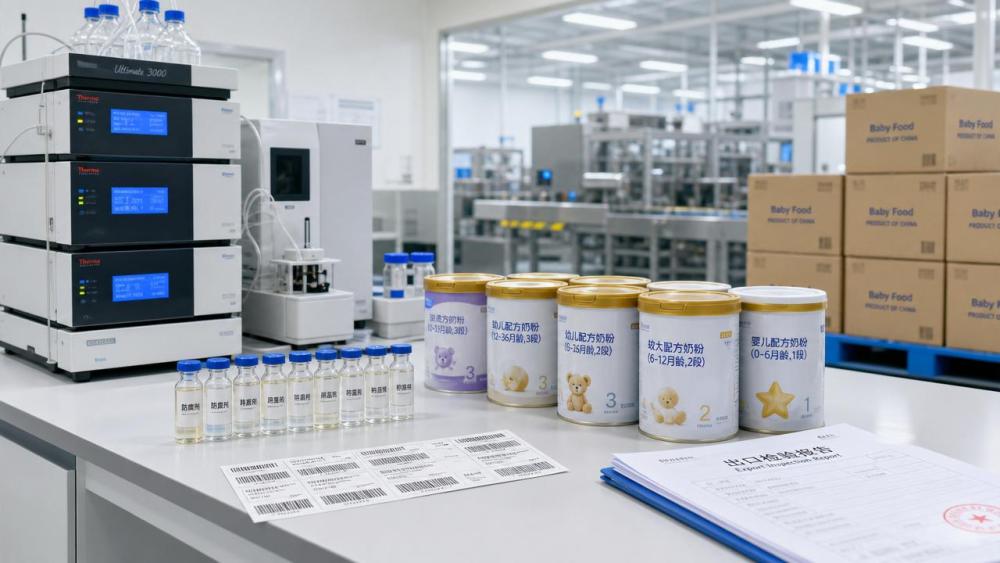
According to the information provided, from June 2026 China’s customs authority began annual special sampling inspections covering preservatives used in infant and young child food, including potassium sorbate, sodium dehydroacetate, and natamycin, as well as active peptide ingredients.
The inspection rate has been raised to 18%. Exporting companies are also required to submit supplier qualification materials for raw ingredients, HPLC-based purity test reports for preservatives, and full-chain batch traceability codes spanning from ingredient input to finished product.
The same measure has already led some importers in Southeast Asia to pause orders temporarily and ask Chinese suppliers to provide third-party microbial challenge test data.
Where pressure may appear across the trade chain
Export documentation moves closer to shipment readiness
From an industry perspective, direct trading companies may feel the first impact in export preparation. The new requirement ties customs inspection more closely to supplier credentials, purity testing, and end-to-end batch coding, which means shipment files may need to be more complete before goods are released for export.
Ingredient sourcing comes under sharper scrutiny
For raw material procurement teams, the immediate issue is not only whether preservatives are compliant, but whether upstream supplier qualifications can be presented in a form that supports customs review. What deserves closer attention is that ingredient compliance and documentary completeness now appear more closely connected.
Manufacturing records become part of trade risk control
For processors and manufacturers, the requirement for traceability codes from dosing through finished goods may affect internal recordkeeping, batch mapping, and handover between production and compliance teams. Analysis shows that the operational burden may fall less on formulation changes and more on whether plant-side records can be retrieved quickly and matched to export batches.
Buyers and service providers may adjust transaction pacing
For overseas buyers, especially those already requesting third-party microbial challenge test data, the practical concern may be delivery certainty and product assurance during customs review. Supply chain service providers may also need to watch for document-check timing, cargo release coordination, and communication gaps when orders are already scheduled.
What companies should watch now
Separate confirmed rules from customer-side add-ons
The confirmed requirement in the provided information covers supplier qualifications, HPLC purity reports, and full-chain batch traceability. By contrast, requests for third-party microbial challenge testing are currently described as buyer-side responses from some Southeast Asian importers. Companies should distinguish between formal compliance obligations and additional commercial conditions raised by customers.
Check whether priority products face slower order conversion
Businesses handling infant and young child food exports that involve the named preservatives or active peptide ingredients should pay close attention to whether quotation, order confirmation, or customs clearance timelines begin to lengthen. Observably, the issue is not limited to testing itself, but extends to the speed at which supporting materials can be assembled and verified.
Review traceability depth before the next shipment cycle
Because the requirement reaches from ingredient input to finished goods, companies may need to verify whether existing batch coding systems can connect supplier records, production use, and final export documents without manual gaps. This is a practical checkpoint rather than a theoretical one, especially where multiple suppliers or frequent batch changes are involved.
Prepare for more detailed buyer communication
With some importers already pausing orders and asking for extra microbial data, customer communication may require earlier explanation of available certificates, testing scope, and expected release timing. From an industry perspective, companies that clarify what is officially required and what can be additionally supported may be better positioned to reduce negotiation delays.
Why this looks like more than a routine inspection update
Analysis shows that this development is not simply about a higher spot-check percentage. It also signals a stronger linkage between ingredient verification, traceability, and export execution in a sensitive product category. That does not by itself prove a lasting shift in trade volume or buyer structure, but it does suggest that compliance proof is becoming more operationally visible.
It is more appropriate to understand this as a regulatory and transaction signal that deserves continued observation rather than as a finalized market outcome. The confirmed facts already show a change in inspection intensity and document requirements, while the buyer response in Southeast Asia indicates that commercial expectations may move in parallel with official checks.
How to read the current signal
At this stage, the information points to a near-term tightening in export verification for infant and young child food involving specified preservatives and active peptide ingredients. A neutral reading is that the biggest immediate issue may be execution readiness: whether exporters can present qualified suppliers, HPLC purity reports, and full-chain traceability quickly enough to support shipments and reassure buyers.
For the industry, the development is best read as a concrete short-term compliance change with possible longer-tail implications for buyer requirements and order rhythm. Whether it develops into a broader structural shift still requires further observation.
Basis of this article and follow-up checks
This article is based on the user-provided news title, event date, and event summary. The content has been written from that supplied information only and does not add unverified policy numbers, company data, market figures, or external links.
For this type of development, commonly relevant source categories may include official notices, company disclosures, industry association updates, authoritative media coverage, and standard-setting documents. A specific official source link was not provided in the input, so the exact source document should continue to be verified. Follow-up attention should focus on any further official wording changes, implementation details in customs practice, and whether additional buyer-side testing requests become more common.
Related News
- Flavour preservation failures caused by oxygen exposure in beveragesOct 01, 2026Food Preservation Scientist
- Which flavour preservation method best protects citrus top notes?Sep 30, 2026Food Preservation Scientist
- How functional additives for beverages affect shelf-life stabilitySep 11, 2026Food Preservation Scientist
- Ingredient selection for preservatives when pH limits antimicrobial efficacySep 07, 2026Food Preservation Scientist
Related News
- 00
0000-00
2026 Osong Cosmetics and Beauty Expo Concludes in South Korea - 00
0000-00
How to compare cosmetic active compounds by their cost in use - 00
0000-00
HKBU Showcases DR2 Following NMPA Registration as a New Cosmetic Ingredient - 00
0000-00
How to use ingredient market insights to forecast sourcing costs - 00
0000-00
Galderma Marks 30 Years of Hyaluronic Acid Injectable Innovation
Food Preservation Scientist
Weekly Insights
Stay ahead with our curated technology reports delivered every Monday.