





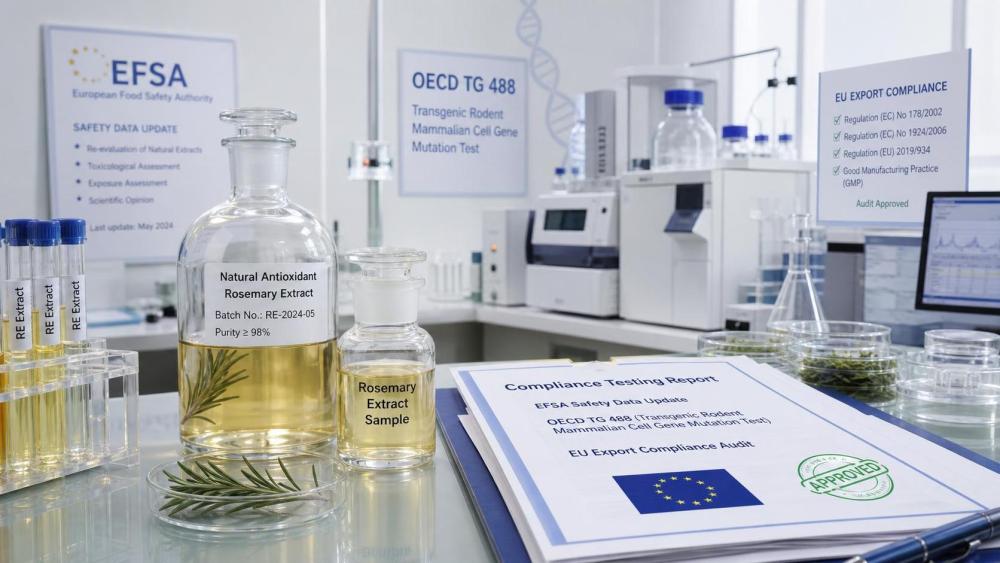
On July 26, 2026, the European Food Safety Authority (EFSA) signaled a concrete compliance change for natural antioxidants used in food, dietary supplements, and functional cosmetic formulations entering the EU market. The update centers on a new round of safety reassessment and, from August 1, 2026, makes OECD TG 488 in vitro micronucleus testing together with updated toxicokinetic data mandatory for new applications and renewal filings. For exporters, formulators, and supply-chain partners, the issue is not only the scientific requirement itself, but also how it may affect dossier preparation, approval timing, and market access planning.
What EFSA Confirmed on July 26
According to the provided event information, EFSA issued a notice on July 26, 2026 regarding a new safety reassessment of natural antioxidants, including examples such as rosemary extract and ascorbyl palmitate. The notice requires that, effective August 1, 2026, all newly submitted products and products seeking renewal must provide in vitro micronucleus test data based on OECD TG 488, along with updated toxicokinetic data. The stated impact concerns compliance access routes and time to market for food, dietary supplement, and functional cosmetic formulators exporting to the European Union.
Where the Compliance Pressure Is Likely to Appear First
Export dossiers may become more documentation-dependent
From an industry perspective, exporters shipping relevant products to the EU are likely to feel the change first at the filing stage. The reason is straightforward: the new requirement is tied directly to new applications and renewals. What deserves closer attention is whether existing technical files, test packages, and supporting compliance documents are sufficient for submissions made on or after the effective date.
Formulation and ingredient sourcing decisions may need earlier validation
Manufacturers and raw material buyers using natural antioxidants in finished formulations may be affected because ingredient selection is linked to the evidence needed in a regulatory file. Analysis shows that procurement and formulation teams should pay closer attention to whether suppliers can provide data packages that support the required testing and updated toxicokinetic documentation, especially where export scheduling depends on a renewal or fresh market entry process.
Testing and compliance service providers may see tighter review expectations
Testing laboratories and regulatory support providers may also be affected because the notice specifies the type of test data to be submitted. Observably, the pressure here is less about commercial demand in general and more about whether documentation, report structure, and technical support can align with the stated EFSA requirement in time for customer submissions.
Delivery planning may be affected by submission timing
For supply-chain and commercial teams, the practical impact may show up in launch sequencing, replenishment planning, and customer commitments tied to products that need a new filing or renewal. It is more appropriate to understand this as a compliance-linked delivery risk rather than a confirmed market outcome, because the provided information identifies a filing requirement change but does not define case-by-case review timelines.
Practical Issues Companies Should Watch Now
Check whether pending filings fall after the effective date
Analysis shows that companies with products preparing for new submission or renewal should first map which dossiers are expected to move on or after August 1, 2026. That timing matters because the notice links the new data requirement directly to those filing categories.
Review the completeness of technical documents
What deserves closer attention is the readiness of existing technical files. Companies should focus on whether current submission materials already include OECD TG 488 in vitro micronucleus testing and updated toxicokinetic data, or whether additional work may be needed before filing. This is a document-control and compliance-screening issue, not just a laboratory question.
Reassess supplier support for regulated ingredients
For businesses sourcing natural antioxidants from third parties, the immediate concern is whether suppliers can support downstream EU compliance needs with usable technical documentation. Observably, procurement teams may need to look more closely at supplier qualification, data availability, and the practicality of using a given ingredient in products intended for EU-bound applications or renewals.
Monitor how execution language develops after the notice
The provided information confirms the new requirement and effective date, but it does not provide detailed enforcement wording, review practice, or document interpretation standards. From an industry perspective, companies should continue watching for later clarification that could affect submission strategy, technical file expectations, or how buyers and partners update their own specification and acceptance requirements.
Why This Reads as an Execution Signal, Not Just a Research Update
Analysis shows that this development is more than a general scientific review notice because it attaches a clear submission requirement and a near-term effective date to new applications and renewals. At the same time, it should not be overstated as a fully defined market outcome. The more balanced reading is that EFSA has sent an execution-level compliance signal, while the exact operational consequences for approval pace, procurement standards, and customer-side acceptance may still depend on how the requirement is applied in practice and how industry participants respond.
How the Market Is Most Reasonably Reading It Now
At this stage, the update is best understood as a live compliance change with immediate relevance for dossier planning, supplier coordination, and export readiness into the EU for affected product categories. It does not by itself confirm broader commercial results, but it does indicate that companies relying on natural antioxidants in regulated product pathways should treat testing evidence and toxicokinetic documentation as near-term priorities. The key takeaway is not speculation about market direction, but the need for closer control over submission timing and technical file completeness.
Basis of This Article and What Still Needs Verification
This article is based on the user-provided news title, event date, and event summary. For developments of this kind, commonly relevant source types may include official notices, releases from regulatory authorities, trade or customs authorities, industry association updates, standard-related documents, and reporting by established professional media. No specific official source link was provided in the input, so the exact official publication record still needs continued verification. Observably, the points that still require follow-up include any later implementation detail, certification or review interpretation, changes in procurement or tender documentation, industry feedback, and how companies execute against the new requirement in practice.
Related News
- How to assess a food antioxidants distributor’s traceability practicesOct 11, 2026Food Preservation Scientist
- How natural antioxidants for oils can prevent rancidity in storageSep 25, 2026Food Preservation Scientist
- How to choose natural antioxidants for beverages with longer shelf lifeAug 23, 2026Food Preservation Scientist
- EU Tightens MRLs for Three Pesticides, Prompting Raw Material Checks for Natural Antioxidant ExportsAug 17, 2026Food Preservation Scientist
Related News
- 00
0000-00
2026 Osong Cosmetics and Beauty Expo Concludes in South Korea - 00
0000-00
How to compare cosmetic active compounds by their cost in use - 00
0000-00
HKBU Showcases DR2 Following NMPA Registration as a New Cosmetic Ingredient - 00
0000-00
How to use ingredient market insights to forecast sourcing costs - 00
0000-00
Galderma Marks 30 Years of Hyaluronic Acid Injectable Innovation
Food Preservation Scientist
Weekly Insights
Stay ahead with our curated technology reports delivered every Monday.