





On July 27, 2026, the U.S. Food and Drug Administration issued an emergency notice that changes the compliance timetable for certain natural antioxidants used in exported FMCG formulations headed to the U.S. market. The notice requires the immediate re-submission of GRAS dossiers for rosemary extract, tocopherol blends, and ascorbyl palmitate, with the new requirement taking effect on August 15, 2026. For companies involved in food, beverage, and cosmetic exports, the immediate concern is not only documentation, but also how updated testing demands may affect import clearance, supplier review, and formulation readiness.
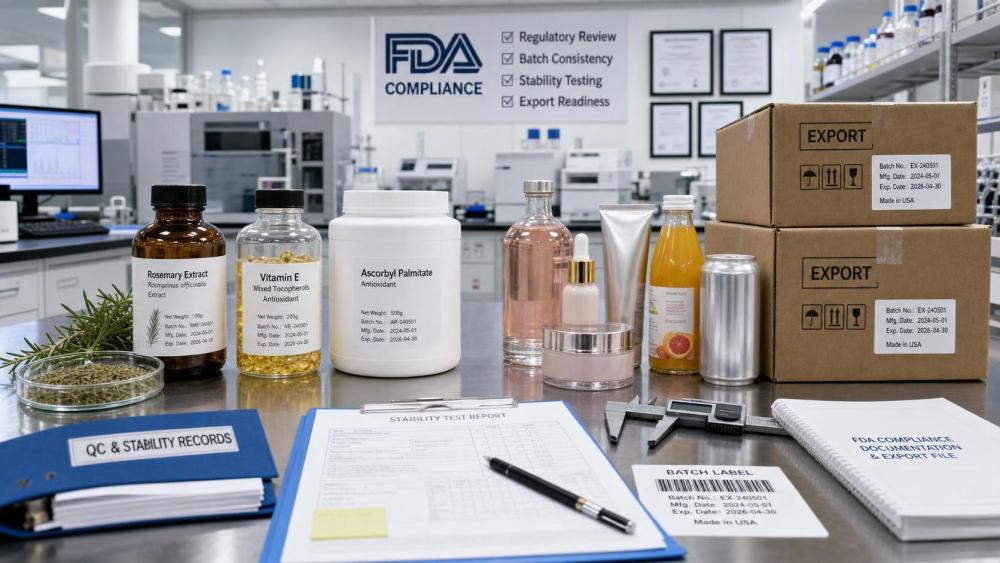
What the FDA Notice Confirms
Based on the information provided, the FDA emergency notice applies to rosemary extract, tocopherol blends, and ascorbyl palmitate used in exported food, beverage, and cosmetic formulations entering the U.S. market. The notice was released on July 27, 2026, and becomes effective on August 15, 2026.
The update requires immediate re-submission of GRAS dossiers for these substances. It also adds two specific technical expectations: new batch-specific stability data and migration testing conducted under simulated export-condition thermal cycling.
The confirmed direct implications identified in the notice summary are effects on overseas buyers' import clearance timelines, supplier qualification audits, and formulation compliance for products entering the United States.
Where Pressure May Appear Across the Supply Chain
Export-oriented manufacturers may face document and formulation bottlenecks
From an industry perspective, manufacturers shipping food, beverage, or cosmetic products to the U.S. may be affected first because the notice targets ingredients already used in finished formulations. The pressure point is likely to appear in dossier readiness, technical file updates, and the ability to show that ingredient use remains aligned with the revised submission expectations.
Ingredient buyers and sourcing teams may need tighter supplier checks
Analysis shows that procurement teams using rosemary extract, tocopherol blends, or ascorbyl palmitate may need to revisit supplier qualification materials. The stated requirement for batch-specific stability data suggests that documentation quality at the lot level may become more important in practical review and purchasing decisions.
Importers and overseas buyers may see timing risks
Observably, overseas buyers and U.S.-bound import programs are exposed to timing risk because the summary explicitly links the notice to import clearance timelines. Even where supply remains available, documentation gaps or delayed resubmissions could become a commercial issue if shipments and compliance files move out of sync.
Service providers in compliance and logistics may need closer coordination
Testing partners, regulatory support teams, and supply chain service providers may also be affected because the notice connects technical testing requirements with real market entry timing. What deserves closer attention is the interaction between simulated export-condition thermal cycling tests and shipment planning, especially where compliance review depends on complete supporting files.
What Companies Should Watch Immediately
The gap between current files and the new submission threshold
Companies should first identify whether existing GRAS dossiers for the named antioxidants already contain the specific data now required. The key practical issue is whether current files can support immediate re-submission or whether new batch-linked testing work is needed before dossiers are considered complete.
Batch-level evidence and test readiness
The notice places clear weight on batch-specific stability data. In practical terms, businesses should pay close attention to how batch records, technical specifications, and testing outputs are organized, reviewed, and matched to exported formulations.
Thermal cycling requirements in cross-border product planning
Another point for close monitoring is the new migration testing requirement under simulated export-condition thermal cycling. Companies involved in long-distance export flows should distinguish between ordinary internal quality data and test results that are responsive to this specific FDA expectation.
Customer communication and delivery commitments
Because the summary explicitly points to import clearance and supplier qualification audits, businesses may need to prepare for customer questions around compliance status, document resubmission progress, and shipment timing. This is especially relevant where buyers require pre-clearance documentation before goods move or before contracts are fulfilled.
Why This Looks More Like a Compliance Signal Than a Finished Outcome
Analysis shows that this development is best understood as an active regulatory signal rather than a fully settled market outcome. The confirmed facts establish a near-term compliance change with a defined effective date, but they do not by themselves prove how broadly delays, reformulations, or sourcing shifts will materialize across all affected sectors.
It is more appropriate to understand this as a short-term operational issue with possible longer-term significance if the reassessment approach becomes a reference point for how natural antioxidant dossiers are reviewed in export-facing FMCG categories. For now, the industry still needs to watch how the notice is interpreted in actual file review, audit practice, and import handling.
How the Market Should Read the Development for Now
At this stage, the most grounded reading is that the FDA notice creates an immediate documentation and testing priority for companies using the named antioxidants in products entering the U.S. It should not yet be overstated as a definitive restructuring of the market, but it also should not be treated as a routine administrative update.
From an editorial perspective, the development is most reasonably viewed as a near-term compliance disruption with broader signaling value. The practical impact will depend on how quickly affected businesses can align dossiers, testing records, supplier materials, and buyer communications with the updated requirement.
Basis of This Article and Ongoing Verification
This article is based on the user-provided news title, event date, and event summary concerning the FDA emergency notice issued on July 27, 2026. No additional unverified facts, company names, policy numbers, market data, or source links have been added.
For this type of development, relevant source categories would typically include official agency notices, company compliance disclosures, trade association updates, authoritative media reporting, and technical or standards-related documents. However, a specific official source link was not provided in the input, so further verification remains necessary.
Areas that merit continued attention include any follow-up FDA wording, how the re-submission requirement is applied in practice, whether documentation expectations are clarified further, and how import clearance and supplier audit procedures respond after the August 15, 2026 effective date.
Related News
- How to assess a food antioxidants distributor’s traceability practicesOct 11, 2026Food Preservation Scientist
- How natural antioxidants for oils can prevent rancidity in storageSep 25, 2026Food Preservation Scientist
- How to choose natural antioxidants for beverages with longer shelf lifeAug 23, 2026Food Preservation Scientist
- EU Tightens MRLs for Three Pesticides, Prompting Raw Material Checks for Natural Antioxidant ExportsAug 17, 2026Food Preservation Scientist
Related News
- 00
0000-00
Bairun Nine-Month Profit Up 20.4% to RMB 662m; Flavors and Fragrances Also Grow - 00
0000-00
How biomimetic peptides work in anti-aging skincare formulations - 00
0000-00
2026 Osong Cosmetics and Beauty Expo Concludes in South Korea - 00
0000-00
How to compare cosmetic active compounds by their cost in use - 00
0000-00
HKBU Showcases DR2 Following NMPA Registration as a New Cosmetic Ingredient
Food Preservation Scientist
Weekly Insights
Stay ahead with our curated technology reports delivered every Monday.