





On July 16, 2026, the U.S. FDA moved to urgently re-evaluate the GRAS status of six widely exported natural antioxidants used in FMCG products, after new toxicokinetic findings were published in peer-reviewed studies in June 2026. The immediate requirement for updated safety dossiers on products entering the U.S. market makes this a live compliance issue for importers, exporters, and manufacturers tied to baked goods, plant-based meats, and functional beverages, especially those supplying North America from China and India.
What the FDA has formally changed
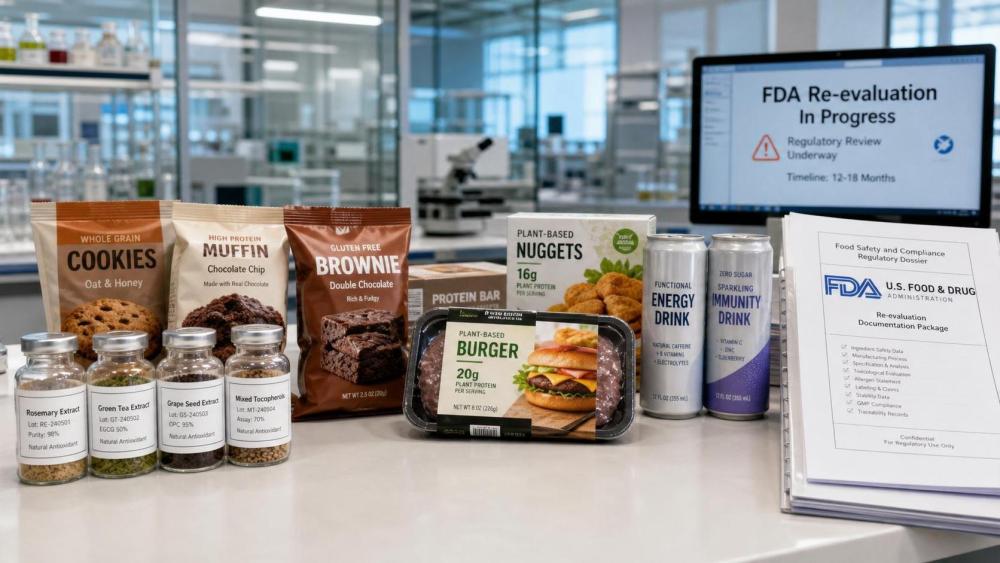
According to the information provided, the FDA has started an urgent re-evaluation of GRAS status for six natural antioxidants that are widely used in exported FMCG products. The ingredients explicitly mentioned include rosemary extract, ascorbyl palmitate, and mixed tocopherols.
The trigger cited for this move is new toxicokinetic data from peer-reviewed studies published in June 2026. Effective immediately, importers must submit updated safety dossiers for products containing these ingredients when those products enter the U.S. market.
The information also states that the development affects more than 70% of Chinese and Indian FMCG exporters supplying baked goods, plant-based meats, and functional beverages to North America.
Where pressure is likely to appear first in the supply chain
Import documentation and market-entry control
From an industry perspective, importers are likely to face the earliest operational pressure because the new requirement applies immediately at the point products enter the U.S. market. The most direct impact is on dossier preparation, submission timing, and the ability to keep documentation aligned with ingredient use.
What deserves closer attention is whether current product files, ingredient specifications, and supporting safety materials are sufficient for the updated filing expectation.
Export manufacturers serving North America
Manufacturers in China and India that ship finished FMCG products into North America may be affected because the ingredients under review are already embedded in export-oriented product formulas. The impact is likely to concentrate on export readiness, shipment scheduling, and coordination with U.S. importing partners.
Observably, the issue is not limited to ingredient legality in the abstract; it reaches day-to-day execution where missing or outdated safety support could slow market entry.
Ingredient sourcing and formulation coordination
Companies purchasing antioxidant ingredients or managing product formulation may also need to pay closer attention. Where rosemary extract, ascorbyl palmitate, mixed tocopherols, or the other reviewed antioxidants are used, the practical question becomes whether existing supplier files can support updated dossier needs.
Analysis shows that procurement and technical teams may need to work more closely, because an ingredient decision now connects more directly to document readiness and U.S. entry procedures.
Category-specific exposure in baked goods, plant-based meat, and beverages
The categories specifically identified in the provided information, baked goods, plant-based meats, and functional beverages, merit focused attention because they are directly named in the affected trade flow. Businesses active in these segments may need to review which SKUs contain the relevant antioxidants and which shipments are exposed to immediate filing requirements.
What companies should watch right now
Track the difference between re-evaluation and final regulatory outcome
Analysis shows that the current development should not be read as a final ban or a completed regulatory decision based on the provided information alone. It is a re-evaluation accompanied by an immediate dossier requirement. That distinction matters for business decisions, because compliance work is urgent even though the long-term regulatory result is not yet defined in the input.
Check product-level documentation, not only ingredient lists
Companies should pay attention to whether affected products have updated and internally consistent safety documentation at the product level. In practical terms, the issue is not only whether a formulation contains one of the reviewed antioxidants, but also whether supporting materials are ready for importer submission without delay.
Align supplier communication with importer requirements
What deserves closer attention is the handoff between ingredient suppliers, finished-goods manufacturers, and U.S. importers. If safety dossiers must be updated immediately, delays may emerge where documentation ownership is unclear or where suppliers and importers are working from different versions of technical materials.
Prioritize exposed product lines and active shipments
For companies with broad FMCG portfolios, the most practical near-term focus is likely to be products already moving into the U.S. market or scheduled for near-term entry. This is especially relevant for businesses concentrated in the categories named in the event summary, where the connection to the FDA action is explicit.
Why this looks like a compliance signal more than a settled outcome
Observably, this development carries two messages at once. First, it creates an immediate operational requirement through updated safety dossiers. Second, it signals that previously accepted ingredient positions can come under renewed review when new scientific data emerges.
It is more appropriate to understand this as an active regulatory signal rather than a concluded market outcome. The facts provided show a procedural tightening tied to new studies, but they do not establish the final status of the six antioxidants after re-evaluation.
From an industry perspective, continued attention is warranted because the affected ingredients are widely used in export FMCG categories and because the impact reaches a large share of Chinese and Indian exporters serving North America.
How the market should read this development
At this stage, the FDA action is best understood as an immediate compliance and documentation issue with broader strategic implications for exporters using natural antioxidants in FMCG formulations. The short-term priority is product entry readiness; the longer-term question is whether the re-evaluation leads to a more durable shift in how these ingredients are supported in cross-border trade.
A neutral reading is the most appropriate one. The event is significant because it changes current filing expectations immediately, but it still requires further observation before the industry can treat it as a final regulatory reset.
Basis of this article and points for continued verification
This article is based on the user-provided news title, event date, and event summary concerning the FDA's emergency alert on GRAS re-evaluation for natural antioxidants in exported FMCG products.
For this type of development, source categories that are typically relevant include official regulatory notices, company disclosures, industry association updates, authoritative media reporting, and standard-setting or scientific publication materials. No specific official source link was provided in the input, so the exact primary source should be continuously verified.
Further monitoring should focus on any updated FDA wording, any clarification on the six antioxidants under review, and any additional guidance affecting dossier expectations for products entering the U.S. market.
Related News
- How to assess a food antioxidants distributor’s traceability practicesOct 11, 2026Food Preservation Scientist
- How natural antioxidants for oils can prevent rancidity in storageSep 25, 2026Food Preservation Scientist
- How to choose natural antioxidants for beverages with longer shelf lifeAug 23, 2026Food Preservation Scientist
- EU Tightens MRLs for Three Pesticides, Prompting Raw Material Checks for Natural Antioxidant ExportsAug 17, 2026Food Preservation Scientist
Related News
- 00
0000-00
2026 Osong Cosmetics and Beauty Expo Concludes in South Korea - 00
0000-00
How to compare cosmetic active compounds by their cost in use - 00
0000-00
HKBU Showcases DR2 Following NMPA Registration as a New Cosmetic Ingredient - 00
0000-00
How to use ingredient market insights to forecast sourcing costs - 00
0000-00
Galderma Marks 30 Years of Hyaluronic Acid Injectable Innovation
Food Preservation Scientist
Weekly Insights
Stay ahead with our curated technology reports delivered every Monday.