





On July 31, 2026, the FDA released an operational update to its GRAS notification program that changes the filing threshold for new natural antioxidants entering the U.S. review path. For exporters, ingredient suppliers, compliance teams, and buyers handling products such as rosemary extract, tea polyphenols, and vitamin E derivatives, the immediate issue is not only the rule change itself but also its effect on submission timing, test preparation, and the documentation base required before trade can move forward.
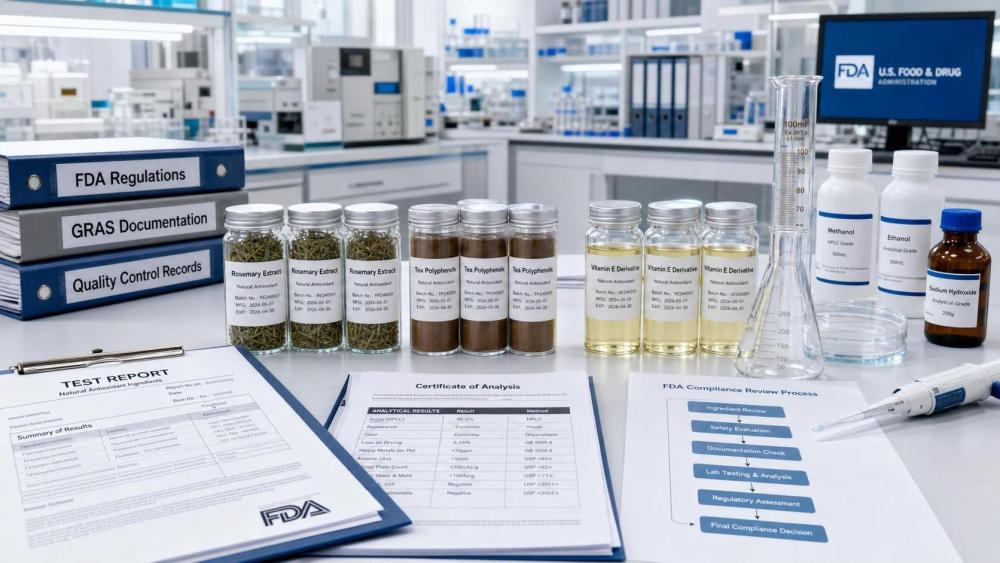
What the FDA Update Now Requires
According to the information provided, the FDA issued the GRAS Notification Program Operational Update on July 31, 2026. The update requires all newly notified natural antioxidants to complete a full toxicology package under OECD guidelines before a GRAS notification is submitted.
The required package includes a 28-day repeated-dose study, genotoxicity testing, and metabolic stability testing. The data package must be issued by an OECD GLP-certified laboratory. The new requirement took effect immediately upon release.
The confirmed scope described in the provided information includes natural antioxidants such as rosemary extract, tea polyphenols, and vitamin E derivatives. The same information also states that the change directly affects approval timing and compliance costs for Chinese raw material suppliers exporting to the U.S.
Where the Pressure Will Show First in the Supply Chain
Export pipelines may face a longer front-end preparation phase
From an industry perspective, exporters are likely to feel the impact at the pre-submission stage. Because the toxicology package must be completed before filing, the compliance burden moves earlier in the export process. What deserves closer attention is the coordination between product readiness, testing completion, and filing schedules, since missing data would no longer be a matter of later supplementation before submission.
Procurement teams may need to reassess supplier readiness
For buyers and sourcing teams, the issue is less about the ingredient name alone and more about whether a supplier can present a complete OECD-guideline toxicology package from an OECD GLP-certified laboratory. Analysis shows that procurement reviews may need to place greater weight on laboratory qualification, report completeness, and document availability when evaluating supply continuity for the U.S. market.
Manufacturing and formulation planning may become more document-dependent
Processors and manufacturers using these ingredients may need to watch how the new filing condition affects formulation timelines and material onboarding. If an ingredient intended for the U.S. market cannot move into the notification process without the full data package, internal planning around launch timing, regulatory review, and customer delivery may become more dependent on upstream documentation status.
Testing and compliance service providers may see higher scrutiny
Certification-related service providers and testing institutions connected to export preparation are also implicated by the rule change. The key point is that the update explicitly ties submission eligibility to OECD-guideline testing and OECD GLP laboratory output. Observably, this raises the practical importance of test scope alignment, report format, and the credibility of the issuing laboratory in cross-border compliance work.
What Companies Should Check Now
Review whether current dossiers are submission-ready
Companies preparing new GRAS notifications for natural antioxidants should examine whether their existing toxicology materials already cover the stated OECD-guideline requirements. Where testing has been done in part, the practical question is whether the package is complete enough for pre-filing use under the updated process.
Verify laboratory qualifications and report traceability
Because the provided information specifies that the data package must come from an OECD GLP-certified laboratory, companies should focus on laboratory status, report issuance, and file traceability. Analysis shows that this is not only a testing matter but also a documentation control issue that can affect regulatory review readiness.
Adjust procurement and delivery timelines for U.S.-bound business
The title information indicates that a complete toxicology package must be submitted 90 days in advance, while the event summary emphasizes completion of the full package before GRAS notification. Based on the provided information, companies should treat timeline management as a live compliance issue and continue to verify how filing schedules, purchase commitments, and delivery planning need to be aligned in practice.
Watch for later clarification in execution language
The provided information confirms the operational change and its immediate effect, but it does not include further execution details. For that reason, companies should continue monitoring how the rule is described in later official wording, commercial documents, and compliance communications, especially where submission timing and dossier expectations may require clearer operational interpretation.
Why This Looks Like an Execution Signal Rather Than a Distant Policy Debate
Analysis shows that this update is better understood as an active compliance threshold for new natural antioxidant filings, not as a broad policy discussion with uncertain timing. The reason is that the requirement is framed around what must be completed before a GRAS notification can even be submitted, and the rule is stated to take effect immediately.
At the same time, it is still necessary to separate confirmed facts from later market interpretation. Observably, the immediate facts concern test completion, laboratory qualification, and effectiveness upon release. Questions about how different companies will absorb the cost, how customers will revise sourcing behavior, or how quickly supporting documents will change remain matters for continued observation rather than settled outcomes.
How the Market Should Read This Update
The more appropriate reading at this stage is that the FDA has raised the entry requirements for new GRAS notifications involving natural antioxidants by moving toxicology completeness and laboratory qualification to the front of the process. For companies connected to exports to the U.S., the practical significance lies in compliance sequencing, supplier documentation, and delivery planning rather than in headline interpretation alone.
A measured conclusion is that this is already a landed procedural change, while its full commercial and operational impact still needs to be tracked through implementation, document practice, and market response.
Basis of This Article and What Still Needs Verification
This article is based on the user-provided news title, event date, and event summary. For developments of this kind, relevant source types typically include official notices, regulator releases, trade or customs information, industry association updates, standard-setting documents, and reporting by authoritative media.
No specific official source link was provided in the input, so the exact official link still needs to be verified on an ongoing basis. Continued attention should also be given to any later detail on implementation language, certification practice, tender or procurement document changes, industry feedback, and how companies are executing against the new requirement.
Related News
- How to choose natural antioxidants for beverages with longer shelf lifeAug 23, 2026Food Preservation Scientist
- EU Tightens MRLs for Three Pesticides, Prompting Raw Material Checks for Natural Antioxidant ExportsAug 17, 2026Food Preservation Scientist
- China Customs Tightens Export Filing for Food Ingredients, Raising Clearance RisksAug 16, 2026Food Preservation Scientist
- How food antioxidants for oils help prevent rancidityAug 16, 2026Food Preservation Scientist
Related News
- 00
0000-00
How biodegradable surfactants for laundry affect cold-water cleaning - 00
0000-00
How food hydrocolloids prevent ice crystals in frozen desserts - 00
0000-00
Which food texture modifiers for sauces prevent thinning after reheating? - 00
0000-00
How to verify supplier references for active compounds - 00
0000-00
How functional additives for beverages affect shelf-life stability
Food Preservation Scientist
Weekly Insights
Stay ahead with our curated technology reports delivered every Monday.