





Understanding essential oil ingredients begins with a simple but consequential question: what is really inside the bottle, and how reliably will it perform over time?
Across fragrance, personal care, home care, and selected FMCG formulations, purity, stability, and accurate labeling shape safety, scent character, compliance, and commercial credibility.
That matters even more in markets where clean label language, sensory differentiation, and regulatory scrutiny now move together rather than separately.
For platforms such as FFAI, which tracks flavors, fragrances, cosmetic actives, and ingredient compliance, essential oil ingredients sit at a useful intersection of chemistry, formulation, and market intelligence.
What essential oil ingredients actually include
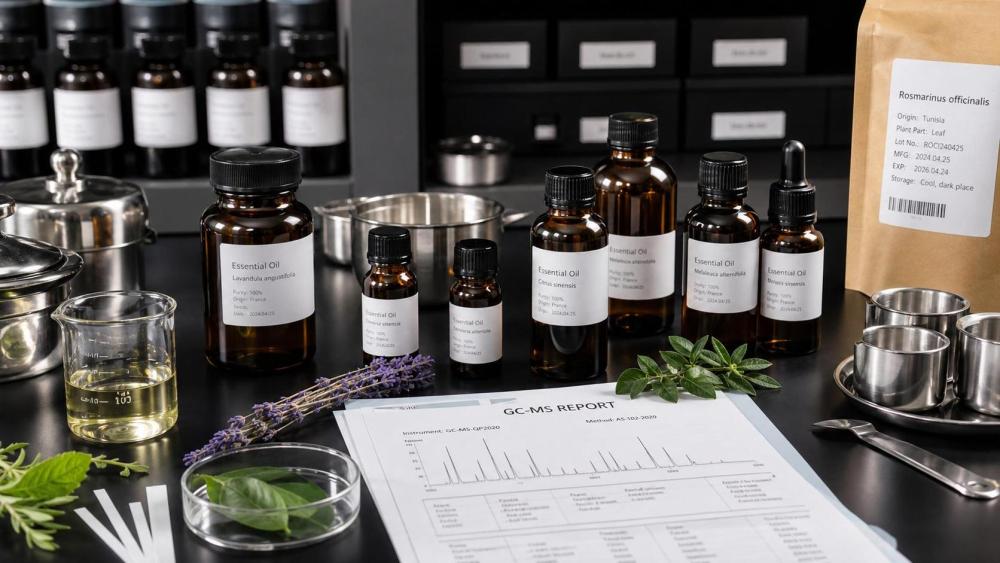
At first glance, an essential oil may seem like a single natural material. In practice, it is a complex mixture of volatile compounds.
These compounds often include terpenes, terpene alcohols, esters, aldehydes, ketones, oxides, and trace molecules that influence both odor and functionality.
Lavender oil, for example, is valued partly for linalool and linalyl acetate. Citrus oils are shaped by limonene, while tea tree oil is judged heavily by terpinen-4-ol.
So when people discuss essential oil ingredients, they are really discussing composition, proportion, source variation, and the way those variables affect end use.
This is why the same named oil can behave differently across batches, origins, extraction methods, and storage histories.
Why purity is more than a marketing claim
Purity is often reduced to a vague promise of being natural or undiluted. In technical terms, it is a question of identity, contamination, and adulteration risk.
A pure oil should match its expected botanical source and compositional profile. It should also be free from undeclared carriers, synthetic extenders, or problematic residues.
Adulteration remains a practical issue because many essential oils are expensive, seasonally constrained, and exposed to volatile raw material pricing.
Cheaper terpene fractions, synthetic aroma chemicals, or diluted blends can imitate a sensory signature while reducing authenticity and traceability.
From a business perspective, low purity does not just weaken brand trust. It can also distort formulation performance, trigger labeling errors, and complicate export documentation.
That concern aligns with FFAI’s broader focus on high-purity ingredients, where commercial value increasingly depends on defensible quality rather than attractive storytelling alone.
What usually signals a stronger purity profile
- Clear botanical naming, including genus, species, and plant part.
- Declared extraction method, such as steam distillation or cold pressing.
- Batch-specific analytical data, especially GC-MS or GC-FID results.
- Traceable origin and harvest information where relevant.
- Statements on allergens, solvents, and residual contaminants.
Stability decides whether quality survives the supply chain
Essential oil ingredients are chemically active and often fragile. Exposure to oxygen, light, heat, and moisture can shift their composition long before a product reaches end use.
Oxidation is one of the main concerns. Citrus oils rich in limonene, for instance, can degrade into oxidation products that alter aroma and increase sensitization concerns.
A fresh, sparkling top note can flatten into something dull, resinous, or harsh. In personal care and fine fragrance, that sensory drift directly affects product perception.
In broader FMCG contexts, instability can also change compatibility with preservatives, surfactants, emulsifiers, and packaging materials.
This is one reason ingredient intelligence matters. Stability is rarely only about storage in a warehouse. It is about how a material behaves through filling, transport, shelf life, and actual formulation stress.
Key stability pressures to watch
Labeling is where chemistry meets regulation
Accurate labeling is often treated as an administrative step, yet it is one of the clearest indicators of ingredient discipline.
For essential oil ingredients, labels should help confirm identity, intended use, handling conditions, and relevant hazard or allergen information.
The required level of detail varies by market and application. A cosmetic ingredient declaration differs from food-related, household, or industrial documentation.
Still, the basic principle remains consistent: if the composition is complex, the label cannot be casual.
That is especially important for cross-border trade. FFAI’s compliance-oriented lens is relevant here, because GRAS pathways, IFRA considerations, SDS requirements, and EU cosmetics notifications all depend on precise substance knowledge.
In other words, weak labels usually signal weak internal control.
Label elements worth checking early
- Botanical identity and common trade name.
- CAS number or other reference identifiers when applicable.
- Batch code and manufacturing date.
- Storage instructions and shelf-life guidance.
- Declared allergens and use restrictions.
- Country of origin and extraction details where commercially relevant.
Where these issues show up in real formulations
Essential oil ingredients are rarely evaluated in isolation. Their practical value appears when they enter systems with other active or functional materials.
In fragrance applications, the main question may be olfactory fidelity over time. In skin care, irritation profile and oxidation stability can move to the front.
In cleansing products, interaction with surfactants, solubilizers, and packaging becomes more visible. In food-adjacent contexts, safety and documentation standards tighten further.
That broader view matches the FMCG reality FFAI follows. Aroma, preservation, rheology, actives, and compliance often converge inside one finished product, not in separate silos.
How to judge essential oil ingredients more effectively
A useful assessment framework usually combines sensory review, analytical proof, storage discipline, and document quality.
Sensory evaluation still matters, but it should not stand alone. A pleasant odor can hide dilution, instability, or undeclared adjustment.
Certificates are also helpful, but only when they are current, batch-linked, and consistent with the claimed origin and composition.
More reliable decisions come from comparing several layers of evidence at once.
A practical review checklist
- Check whether the chemical profile fits the claimed plant source.
- Review oxidation-sensitive markers for older or citrus-heavy materials.
- Confirm storage in sealed, light-protective containers.
- Compare label claims with technical documents and SDS language.
- Test the ingredient inside the actual formulation, not only as a neat sample.
What deserves closer attention next
The most useful next step is not to ask whether an oil is simply natural or premium. It is to define what performance and risk profile the application really demands.
From there, essential oil ingredients can be screened through a more grounded lens: compositional integrity, oxidation behavior, labeling accuracy, and fit with the final system.
That approach is especially valuable in sectors shaped by clean labels, sensory expectations, and tighter compliance standards.
When ingredient review becomes more structured, comparisons get sharper, technical conversations improve, and the gap between attractive claims and actual quality becomes easier to detect.
For ongoing evaluation, it is worth tracking not only aroma and origin, but also analytical consistency, packaging suitability, and the regulatory language attached to each batch.
Related News
- Which essential oil applications suit sensitive skincare formulas?Sep 28, 2026Aromatics & Perfumery Fellow
- Essential Oil Extracts Price: What Drives Cost Differences in 2026Jul 12, 2026Aromatics & Perfumery Fellow
- Supercritical Essential Oil Applications: Best Uses by Product TypeJul 10, 2026Aromatics & Perfumery Fellow
- Ningbo Tightens CO₂ Extract Shipping DeclarationsJul 09, 2026Aromatics & Perfumery Fellow
Related News
- 00
0000-00
2026 Osong Cosmetics and Beauty Expo Concludes in South Korea - 00
0000-00
How to compare cosmetic active compounds by their cost in use - 00
0000-00
HKBU Showcases DR2 Following NMPA Registration as a New Cosmetic Ingredient - 00
0000-00
How to use ingredient market insights to forecast sourcing costs - 00
0000-00
Galderma Marks 30 Years of Hyaluronic Acid Injectable Innovation
Aromatics & Perfumery Fellow
Weekly Insights
Stay ahead with our curated technology reports delivered every Monday.