





The time of the event was not specified in the provided information. However, a sampling inspection notice issued by the Inner Mongolia market regulator has drawn attention to how sensory compliance is being judged in products using Natural Food Colorants together with Xanthan/Alginate Hydrocolloids. For food manufacturers, ingredient suppliers, exporters, buyers, and testing-related service providers, this matters not only as a product quality issue, but also as a regulatory execution signal that formulation compatibility under acidic and high-temperature conditions may receive closer scrutiny in purchasing, compliance review, and delivery acceptance.
What the notice confirmed
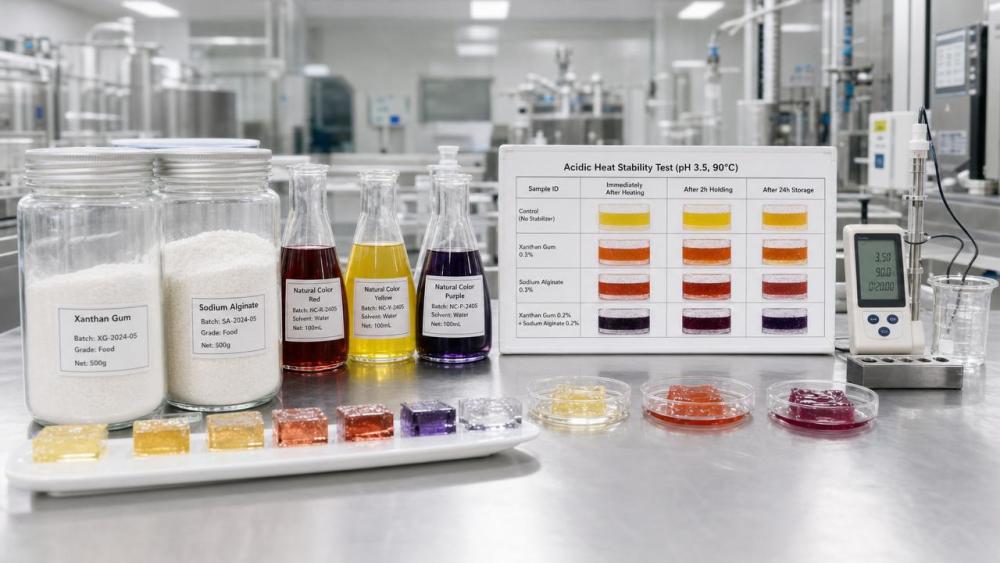
According to the provided summary, the Inner Mongolia market regulator's 2026 Issue No. 5 sampling inspection notice covered 877 batches of food. Among them, two jelly products were determined to be sensory non-compliant because of uneven decolorization of natural food colorants and the failure of synergistic thickening involving Xanthan gum.
The notice is described as a domestic regulatory action. The provided information also states that it exposes compatibility risks involving Natural Food Colorants and Xanthan/Alginate Hydrocolloids in acidic or high-temperature blended systems.
Why this matters across the supply chain
Formulation suppliers may face deeper technical due diligence
From an industry perspective, suppliers of compound stabilizer systems, hydrocolloids, and natural color solutions may be affected because the issue was not framed only around a single raw material, but around performance in a blended application system. The practical impact may appear in specification alignment, technical data review, sample validation, and customer questions about compatibility under specific processing conditions. What deserves closer attention is whether buyers begin asking for more formulation-level evidence rather than relying only on single-ingredient compliance documents.
Food processors and brand-side manufacturers may see stricter acceptance standards
For processors producing jelly and similar systems, the notice suggests that sensory outcomes linked to color behavior and texture stability can become a direct compliance point. Analysis shows this may affect pilot testing, process verification, batch release, and complaint handling. Companies in this position should pay attention to whether existing internal documents, testing reports, and product development files adequately reflect acidic and high-temperature application conditions, especially where multiple stabilizing and coloring ingredients are used together.
Export-facing businesses may encounter trust and documentation pressure
The provided summary explicitly notes a possible impact on overseas clients' confidence in domestically produced compound stabilizer systems. Observably, this could influence export communication, customer audits, pre-shipment technical clarification, and after-sales quality explanations. For export businesses, the immediate issue is less about a confirmed trade restriction and more about whether customers request stronger proof of formulation stability, clearer traceability, or additional product performance documentation before purchase or repeat orders.
Testing and compliance service providers may need to respond to more application-based inquiries
Testing institutions and compliance support providers may also be affected because clients could seek more targeted evaluations tied to end-use systems rather than basic ingredient conformity alone. This may influence report scope, sampling logic, and technical interpretation in customer communication. It is more appropriate to understand this as a possible shift in market attention toward application compatibility evidence, not as a confirmed new regulatory standard.
What companies should watch next
Review whether technical files match real processing conditions
Analysis shows companies using Natural Food Colorants with Xanthan/Alginate Hydrocolloids should recheck whether their technical files, internal validation records, and customer-facing specifications reflect acidic and high-temperature use scenarios. If those conditions are central to the product's application, generic material descriptions may be insufficient for customer review or quality defense.
Prepare for closer questions during procurement and customer audits
What deserves closer attention is the purchasing side. Buyers may increasingly ask how a blended system performs in the final matrix, not just whether each ingredient is individually compliant. Companies should therefore be ready to explain formulation boundaries, expected sensory performance, and any known compatibility limits in a clear and documented way.
Track whether official wording develops beyond this notice
The current information does not provide further enforcement details, expanded testing criteria, or a broader rule change. For that reason, companies should not treat this as evidence of a fully redefined compliance framework. Instead, they should monitor whether later official notices, inspection language, or related compliance communications provide a more detailed execution approach.
Strengthen traceability and post-delivery response capacity
For exporters and domestic suppliers alike, this issue can quickly move from formulation performance into trust management. Observably, stronger batch traceability, more complete application records, and faster after-sales technical response may help reduce friction if customers raise concerns about color uniformity or texture stability after delivery.
How this signal is best interpreted for now
Analysis shows this development is best read as an execution signal rather than as proof of a broad new mandatory rule. The confirmed fact is the regulatory finding on two jelly products and the resulting attention to sensory non-compliance tied to formulation interaction. The broader significance lies in what the notice highlights: compatibility within compound systems can influence regulatory outcomes and market confidence at the same time.
Observably, the market relevance may extend beyond the specific products mentioned in the notice because overseas customers often assess consistency, reproducibility, and technical transparency at the system level. Even without a confirmed policy expansion, businesses may still feel pressure through audits, procurement reviews, and customer confidence checks.
A practical reading of the current development
At this stage, it is more appropriate to understand the notice as a targeted reminder that formulation compatibility can become a compliance and commercial issue when sensory performance fails. It does not, based on the provided information, establish a new formal trade barrier or a fully defined new certification requirement. Still, for companies operating in natural colors, hydrocolloids, jelly applications, and export-oriented ingredient systems, the signal is concrete enough to justify closer review of technical documents, validation logic, and customer communication.
Basis of this article and points still to verify
This article is based on the user-provided news title, event time, and event summary. The specific official source link was not provided in the input and should be further verified. For this type of development, relevant source categories typically include regulatory notices, market supervision releases, customs or trade authority information, industry association updates, standard-setting documents, and reporting by authoritative media.
Further observation is still needed on any follow-up official wording, compliance interpretation, procurement document changes, customer audit expectations, industry feedback, and how companies implement technical or quality adjustments in response.
Related News
- How to assess color stability from a natural food colors manufacturerOct 06, 2026Food Rheology Expert
- How natural food pigments for bakery hold color during bakingSep 20, 2026Food Rheology Expert
- EFSA Tightens MRLs for Natural Food ColorsAug 10, 2026Food Rheology Expert
- EFSA Updates Residue Limits for Natural Colorants, Drawing Attention to China’s Export Compliance PathwaysAug 08, 2026Food Rheology Expert
Related News
- 00
0000-00
2026 Osong Cosmetics and Beauty Expo Concludes in South Korea - 00
0000-00
How to compare cosmetic active compounds by their cost in use - 00
0000-00
HKBU Showcases DR2 Following NMPA Registration as a New Cosmetic Ingredient - 00
0000-00
How to use ingredient market insights to forecast sourcing costs - 00
0000-00
Galderma Marks 30 Years of Hyaluronic Acid Injectable Innovation
Food Rheology Expert
Weekly Insights
Stay ahead with our curated technology reports delivered every Monday.