




On August 8, 2026, the U.S. FDA released an operational update to its GRAS notification program that raises the documentation threshold for new natural antioxidant filings. For exporters, ingredient suppliers, manufacturers, and compliance teams serving the U.S. market, the update is worth close attention because it changes both the technical preparation required before submission and the format in which toxicology data must be delivered, with direct implications for filing timelines and document readiness.
What the FDA update specifically changes
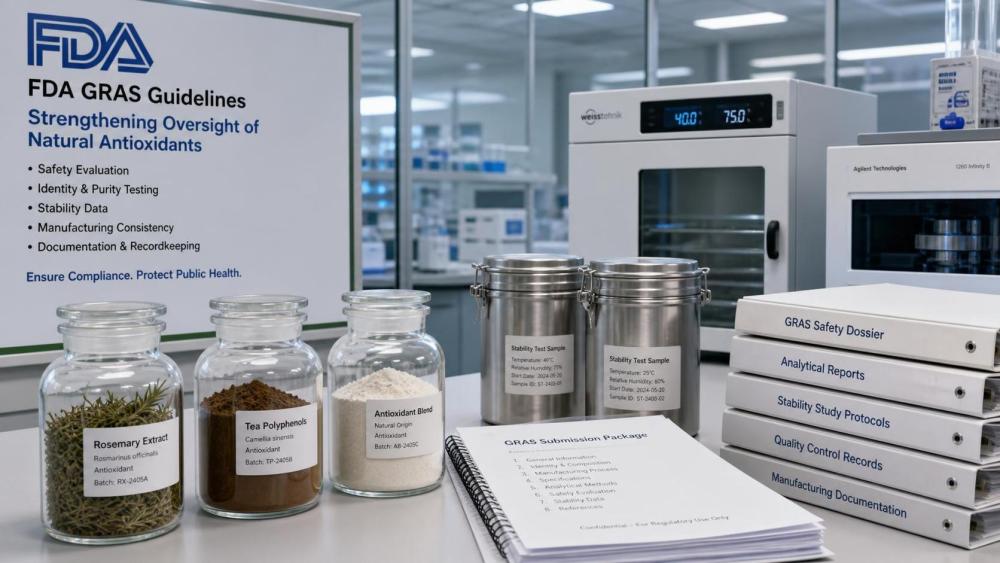
According to the information provided, the FDA issued the GRAS Notification Program Operational Update on August 8, 2026. Under this update, all new notifications for natural antioxidants, including examples such as rosemary extract, tea polyphenols, and ascorbyl palmitate, must complete full-cycle stability testing and migration assessment before a GRAS notification is submitted.
The update also requires structured toxicology data to be uploaded through the eSubmitter 3.2 system. The rule applies to all non-U.S. domestic filers. For Chinese suppliers exporting to the United States, this means compliance strategy and document preparation timelines must be adjusted in parallel with the new filing requirements.
Where the impact is likely to appear first
Exporters facing a longer compliance lead time
From an industry perspective, direct trading companies and exporters are likely to feel the effect at the front end of U.S.-bound business planning. The reason is straightforward: if stability testing, migration assessment, and structured toxicology submission must all be completed before filing, commercial timelines may need to be aligned much earlier with regulatory preparation.
What deserves closer attention is the handoff between sales commitments and regulatory readiness. Companies shipping natural antioxidants into the U.S. market may need to review whether existing quotation, sampling, and order-confirmation cycles still match the new filing sequence.
Ingredient manufacturers under greater documentation pressure
For upstream manufacturers of natural antioxidant ingredients, the update may affect the way technical dossiers are assembled. The impact is not limited to having safety information on hand; it also reaches the format, completeness, and submission readiness of that information because the FDA is requiring structured toxicology data through eSubmitter 3.2.
Observably, this places more emphasis on internal data organization and on whether technical, regulatory, and quality teams can prepare consistent materials for filing support.
Supply chain and service partners pulled into earlier coordination
Supply chain service providers, regulatory consultants, and submission support teams may also be affected because the update changes workflow timing. If the required testing and assessment must be completed before notification, coordination points across laboratories, documentation teams, and filing support functions may shift earlier in the process.
For market participants in these roles, the practical issue is less about the existence of a new rule than about whether cross-border documentation and submission steps can still be completed without disrupting delivery expectations.
U.S.-facing buyers and application companies watching supplier readiness
Procurement teams and downstream application companies using natural antioxidants in products for the U.S. market may need to pay closer attention to supplier preparedness. Analysis shows that when compliance documentation cycles become more demanding, supplier qualification, file completeness, and communication around submission timing become more material to sourcing decisions.
The immediate concern is not necessarily a change in product demand, but whether suppliers can support U.S. market access requirements with complete and properly structured data packages.
What companies should monitor now
Whether current dossiers match the new pre-submission sequence
Companies involved in new GRAS notifications for natural antioxidants should first examine whether their current files already include completed full-cycle stability testing and migration assessment before submission. This is a practical checkpoint because the update, as described, places those items ahead of the filing stage rather than leaving them as later supporting work.
Readiness for eSubmitter 3.2 structured toxicology uploads
A second point is technical submission readiness. The FDA is requiring structured toxicology data through eSubmitter 3.2, so businesses should pay attention to whether existing toxicology materials can be converted and organized in a format suitable for that system. The business issue here is not only data ownership, but also data structure and submission workflow.
Timeline adjustments in customer and supplier communication
Chinese suppliers and other non-U.S. filers should also review how they communicate timelines to customers, agents, and internal commercial teams. Based on the information provided, the filing preparation cycle now carries more mandatory work before submission, which may affect delivery planning, launch coordination, and customer expectations tied to the U.S. market.
Watching for further official clarification
It is also sensible to monitor whether the FDA provides additional clarification on operational details around the update. Analysis shows that regulatory announcements can establish a clear direction while leaving implementation questions that only become visible during actual filing preparation. For now, businesses should distinguish between the confirmed requirements already stated and any assumptions about how review practice may evolve.
How this update is best understood at this stage
This section is an observation rather than a statement of fact. It is more appropriate to understand this update as a clear compliance signal with immediate procedural consequences, rather than as a complete picture of long-term market outcomes. The confirmed facts already indicate a tighter pre-submission standard and a more structured digital filing requirement for new natural antioxidant notifications from non-U.S. filers.
At the same time, continued attention is still necessary because the broader commercial effect will depend on how companies adapt their data preparation, submission workflows, and customer communication. In that sense, the update appears to be both a short-term operational change and a longer-term signal that documentation quality and structured submission capability are becoming more central in U.S.-bound regulatory work.
A measured takeaway for the market
The immediate significance of this development lies in compliance execution rather than in headline-level market interpretation. For natural antioxidant exporters and related supply chain participants, the FDA update points to a more demanding filing path that begins earlier, requires fuller technical preparation before submission, and places greater weight on structured digital data delivery.
Current conditions suggest this should be read as a concrete regulatory adjustment with broader strategic implications still unfolding. For the industry, the most practical response is to focus on filing readiness, document completeness, and coordination across testing, regulatory, and commercial functions.
Basis of this article and what still needs verification
This article is based on the user-provided news title, event date, and event summary. The information described here should typically be cross-checked against source types such as official regulatory notices, company disclosures, industry association updates, authoritative media coverage, and relevant standards or compliance documents.
No specific official source link was provided in the input, so the exact official link remains to be verified on an ongoing basis. Continued monitoring should focus on any further FDA clarification related to operational filing details, implementation interpretation, and follow-up guidance affecting non-U.S. filers and exporters serving the U.S. market.
Related News
- How to choose natural antioxidants for beverages with longer shelf lifeAug 23, 2026Food Preservation Scientist
- EU Tightens MRLs for Three Pesticides, Prompting Raw Material Checks for Natural Antioxidant ExportsAug 17, 2026Food Preservation Scientist
- China Customs Tightens Export Filing for Food Ingredients, Raising Clearance RisksAug 16, 2026Food Preservation Scientist
- How food antioxidants for oils help prevent rancidityAug 16, 2026Food Preservation Scientist
Related News
- 00
0000-00
How ingredient intelligence platforms improve market research decisions - 00
0000-00
How scientific anti-aging skincare targets wrinkles at the cellular level - 00
0000-00
Garlic Powder Storage: Managing Moisture to Protect Aroma and Flow - 00
0000-00
How to select aroma chemical ingredients for better fragrance stability - 00
0000-00
How natural food pigments for bakery hold color during baking
Food Preservation Scientist
Weekly Insights
Stay ahead with our curated technology reports delivered every Monday.