





Cosmetic Peptide Delivery System Technology Explained
For technical evaluation, cosmetic peptide delivery system technology decides whether peptide claims can become visible skin results.
That judgment goes far beyond peptide name recognition.
It depends on carrier architecture, loading efficiency, release control, barrier transport, and regulatory fit.
In practice, cosmetic peptide delivery system technology sits at the center of anti-aging product credibility.
A premium peptide without delivery support often underperforms in finished formulas.
A well-designed system, however, can improve stability, deposition, and repeatable efficacy.
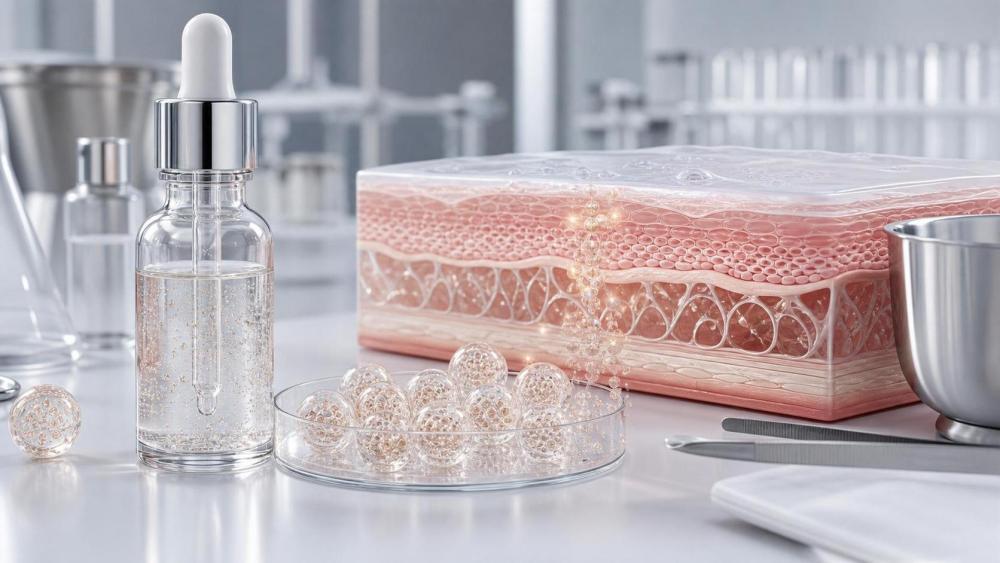
This also explains why ingredient reviews now focus on mechanism, not just active concentration.
From a strategy angle, stronger delivery design can create both efficacy moats and pricing advantages.
Why Peptides Need a Delivery System
Peptides look attractive because they target signaling, repair, firmness, or wrinkle-related pathways.
Yet most peptides face a simple problem.
They are often hydrophilic, structurally fragile, and vulnerable to degradation in water-based systems.
The stratum corneum adds another barrier.
Its lipid-rich structure blocks many molecules before they reach meaningful skin depth.
So cosmetic peptide delivery system technology is not a nice extra.
It is often the condition for functional performance.
Without it, formulation losses can erase the promise seen in supplier data sheets.
Core barriers to evaluate
- Chemical instability from oxidation, hydrolysis, or heat during processing.
- Enzymatic breakdown after skin application.
- Low permeability across the outer skin barrier.
- Incompatibility with surfactants, preservatives, or low pH systems.
- Uncontrolled release that reduces target site exposure.
Main Types of Cosmetic Peptide Delivery System Technology
Several platforms dominate current cosmetic peptide delivery system technology.
Each solves a different balance of protection, penetration, cost, and sensory performance.
1. Liposomes and phospholipid vesicles
These are classic carriers for sensitive actives.
They can encapsulate hydrophilic peptides and improve skin affinity through phospholipid membranes.
Their strength is biomimetic delivery.
Their weakness is physical instability, oxidation sensitivity, and scale-up complexity.
2. Nanoemulsions and microemulsions
These systems improve distribution and can support better deposition on skin.
They are often favored for elegant texture and transparent serum formats.
Still, surfactant load and long-term peptide compatibility require careful review.
3. Polymeric capsules and microspheres
These carriers are useful when controlled release is the main target.
They can shield peptides from external stress during storage and application.
The trade-off is possible residue feel, lower transparency, and regulatory scrutiny on polymer choice.
4. Solid lipid particles and nanostructured lipid carriers
These systems support occlusion, barrier interaction, and active protection.
They can work well in repair creams and richer anti-aging emulsions.
However, crystal behavior and payload leakage must be checked over shelf life.
5. Peptide modification and conjugation
Sometimes the delivery system is built into the molecule.
Lipidation, carrier-linked peptides, or sequence engineering can improve membrane interaction.
This route can be effective, but it changes safety, cost, and claim interpretation.
How to Assess Performance Beyond the Claim
The market is crowded with impressive language around cosmetic peptide delivery system technology.
The real question is whether the system performs under realistic formulation conditions.
A good technical review starts with measurable checkpoints.
Key criteria
- Encapsulation efficiency: How much peptide is truly protected?
- Particle size and distribution: Are the carrier populations stable and consistent?
- Release profile: Is delivery immediate, sustained, or triggered?
- Penetration evidence: Does the data show deposition at relevant skin layers?
- Formulation robustness: Does performance hold after mixing with the final base?
- Shelf stability: What happens after heat, light, freeze-thaw, and transport stress?
This is where many supplier claims become uneven.
Data generated in simple buffers may not predict finished product behavior.
So cosmetic peptide delivery system technology should be judged in the final formulation matrix whenever possible.
Standards, Safety, and Compliance Signals
Technical strength is only part of the decision.
Cosmetic peptide delivery system technology also raises compliance questions.
These become sharper when nano-scale carriers or novel materials are involved.
What to verify
- INCI transparency for both peptide and carrier materials.
- Nano-related disclosure obligations in target markets.
- Residual solvent, impurity, and preservative compatibility data.
- Irritation, sensitization, and cumulative exposure risk.
- Claims language that stays within cosmetic, not drug, boundaries.
From a global commercialization view, the best system is not always the most complex one.
A simpler carrier with cleaner documentation may win faster approvals and smoother brand adoption.
That is especially true in markets sensitive to nano terminology or novel encapsulation claims.
Commercial Value and Formulation Fit
In actual business decisions, cosmetic peptide delivery system technology must justify its cost.
That means linking mechanism to premiumization, claim support, and user experience.
The strongest platforms usually do three things at once.
- Protect expensive peptides from avoidable degradation.
- Enable visible performance within practical use periods.
- Support a sensory profile consumers will accept daily.
This is why FFAI tracks delivery systems alongside high-end cosmetic actives.
A peptide alone rarely defines market success.
The winning formula is usually a stitched combination of molecular efficacy, sensory acceptability, and compliance readiness.
A Practical Review Framework
If you are comparing suppliers, a simple framework keeps cosmetic peptide delivery system technology reviews grounded.
Checklist for decision-making
- Request carrier composition, process summary, and particle specifications.
- Ask for encapsulation, release, and compatibility data in relevant bases.
- Compare in vitro penetration evidence with realistic use concentration.
- Review stability after packaging, transport, and accelerated aging.
- Check market-specific compliance notes before claim development.
- Model cost-in-use, not just cost per kilogram.
That last point matters more than it seems.
A higher-priced delivery platform may still be efficient if it reduces dosage waste or strengthens claim support.
On the other hand, elaborate cosmetic peptide delivery system technology can become a burden if scale-up or compliance slows launch.
So the best choice is rarely the most fashionable option.
It is the one that survives technical, regulatory, and commercial pressure at the same time.
As peptide innovation accelerates, understanding cosmetic peptide delivery system technology becomes essential for selecting credible actives, shaping stronger formulas, and building anti-aging products that perform as promised.
Related News
- What drives Pro-Xylane price differences between cosmetic suppliers?Sep 09, 2026Cosmeceutical Formulator
- Pro-Xylane in Skincare: What Sets Its Anti-Wrinkle Claims ApartJul 15, 2026Cosmeceutical Formulator
- FDA GRAS Notice 1321 clears recombinant pro-xylane analogJul 14, 2026Cosmeceutical Formulator
- EU CPNP Upgrade Adds Batch Purity Proof for Wrinkle ActivesJul 02, 2026Cosmeceutical Formulator
Related News
- 00
0000-00
How to verify compliance documents for cosmetic active compounds - 00
0000-00
How to verify food grade flavor formulation ingredients for safety - 00
0000-00
How to assess an anti-aging ingredients manufacturer’s batch consistency - 00
0000-00
How formulation tips prevent flavor separation in beverage applications - 00
0000-00
How biodegradable surfactants for laundry affect cold-water cleaning
Cosmeceutical Formulator
Weekly Insights
Stay ahead with our curated technology reports delivered every Monday.