





On June 1, 2026, China’s General Administration of Customs put into effect Order No. 280 and Announcement No. 27 of 2026, revising how overseas food manufacturers are registered for exports to China. The change matters most to overseas producers supplying food additives, flavors and fragrances, natural colors, and water-soluble flavor materials for FMCG applications, because it directly affects compliance access, renewal timing, and registration-related cost and efficiency.
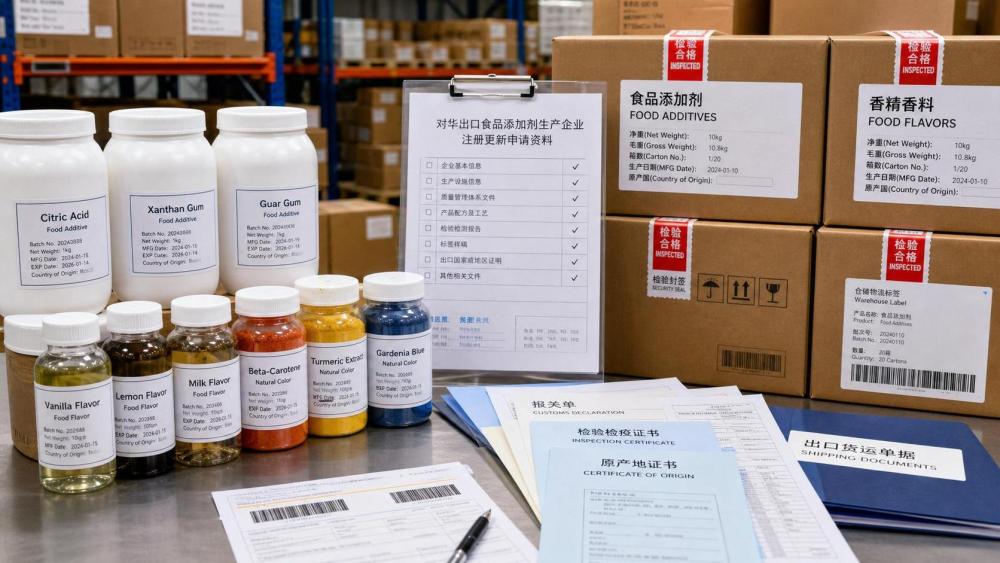
What the new registration arrangement changes
According to the information provided, the new measures optimize registration management for overseas food production enterprises exporting to China. For already registered companies, 95% can obtain automatic renewal. The renewal window has also been extended, allowing renewal handling from 3 to 12 months before registration expiry. For new applications, a faster route described as “list-based registration” has been added.
Where the operational impact is likely to appear
Existing exporters with registrations nearing expiry
From an industry perspective, this group is likely to feel the most immediate effect because renewal timing directly affects whether products can maintain compliant market access. The extension of the renewal window may reduce pressure in document preparation and registration scheduling, while automatic renewal for most registered enterprises may change how companies organize compliance calendars and internal review cycles.
New overseas manufacturers seeking China market entry
For first-time applicants, the newly added list-based registration channel is the key point to watch. Analysis shows that any faster application route can affect onboarding speed, especially for manufacturers supplying ingredients used in FMCG production. The practical impact will likely appear in the early compliance stage, including application sequencing, market-entry planning, and coordination with downstream buyers.
Importers, procurement teams, and supply chain coordinators
Companies that source additives, flavors, fragrances, natural colors, and related functional ingredients may also need to reassess supplier timelines and registration visibility. Observably, even when the policy direction points to higher efficiency, buyers still need clarity on whether a supplier falls under automatic renewal or a new application pathway, because that distinction can affect supply continuity, contracting rhythm, and delivery planning.
What companies should watch in practice
Separate confirmed policy text from execution details
What deserves closer attention is the difference between a stated optimization measure and its operational application in individual business workflows. Companies should closely track how the new renewal and application arrangements are described in official wording and how counterparties interpret them in registration handling.
Review supplier registration status early
For businesses relying on overseas manufacturers, this is a practical moment to check which suppliers are already registered, which ones may qualify for automatic renewal, and which ones may still need a new application route. That review matters most for categories explicitly tied to the policy impact described in the input, including food additives, flavors and fragrances, natural colors, and water-soluble flavor materials.
Recheck documentation and communication timing
Analysis shows that a longer renewal window does not remove the need for documentation discipline. Exporters, importers, and service providers should pay attention to registration validity timing, supporting materials, and communication with customers or partners, especially where supply commitments depend on uninterrupted compliance status.
Prepare for different handling paths across suppliers
Not every supplier will face the same procedural outcome. Some may benefit from automatic renewal, while others may be more affected by the new application pathway. In practice, companies may need separate internal tracking and contingency planning for incumbent suppliers and newly introduced manufacturers.
Why this looks like more than a one-day update
This section is an editorial observation. It is more appropriate to understand this development as both an immediate procedural change and a longer-term policy signal about improving registration efficiency for overseas food manufacturers serving the China market. At the same time, it is still too early to treat efficiency gains as a uniform result across every category and workflow, because the provided information confirms the rule change itself but does not establish how all market participants will experience implementation in practice.
How the industry may best read this change now
At this stage, the most balanced reading is that China has introduced a clearer and potentially more efficient registration framework for a large share of existing overseas food manufacturers, while also creating a faster entry route for some new applicants. For the industry, the significance lies less in headline simplification and more in how renewal timing, supplier qualification, and compliance coordination may now be managed with fewer friction points. It is more appropriate to understand this as a meaningful regulatory update with practical implications, while continuing to monitor how it is applied in day-to-day trade operations.
Basis of this article and what still needs verification
This article is based on the user-provided news title, event date, and event summary. For this type of development, commonly relevant source categories may include official government notices, company disclosures, industry association updates, authoritative media coverage, and standards-related documents. No specific official source link was included in the input, so the exact official link still needs continued verification. Observably, follow-up attention should focus on any further official wording, implementation clarifications, and how the renewal and list-based application paths are reflected in actual cross-border compliance practice.
Related News
- How to verify compliance documents for cosmetic active compoundsSep 19, 2026Dr. Chloe Vance
- How to verify food grade flavor formulation ingredients for safetySep 18, 2026Dr. Chloe Vance
- How to verify clean label ingredients for Europe meet label claimsSep 10, 2026Dr. Chloe Vance
- How essential oil ingredients affect fragrance safety in leave-on productsSep 08, 2026Dr. Chloe Vance
Related News
- 00
0000-00
How to select aroma chemical ingredients for better fragrance stability - 00
0000-00
How natural food pigments for bakery hold color during baking - 00
0000-00
How to verify compliance documents for cosmetic active compounds - 00
0000-00
How to verify food grade flavor formulation ingredients for safety - 00
0000-00
How to assess an anti-aging ingredients manufacturer’s batch consistency
Dr. Chloe Vance
Weekly Insights
Stay ahead with our curated technology reports delivered every Monday.