





Choosing rheology modifiers for dairy products is no longer just a texture decision.
It now affects quality, safety, clean-label credibility, processing stability, and consumer trust across chilled and ambient dairy categories.
As dairy portfolios diversify, texture control must connect sensory design with compliance, shelf life, and repeatable manufacturing performance.
Dairy Texture Is Becoming a Strategic Quality Signal
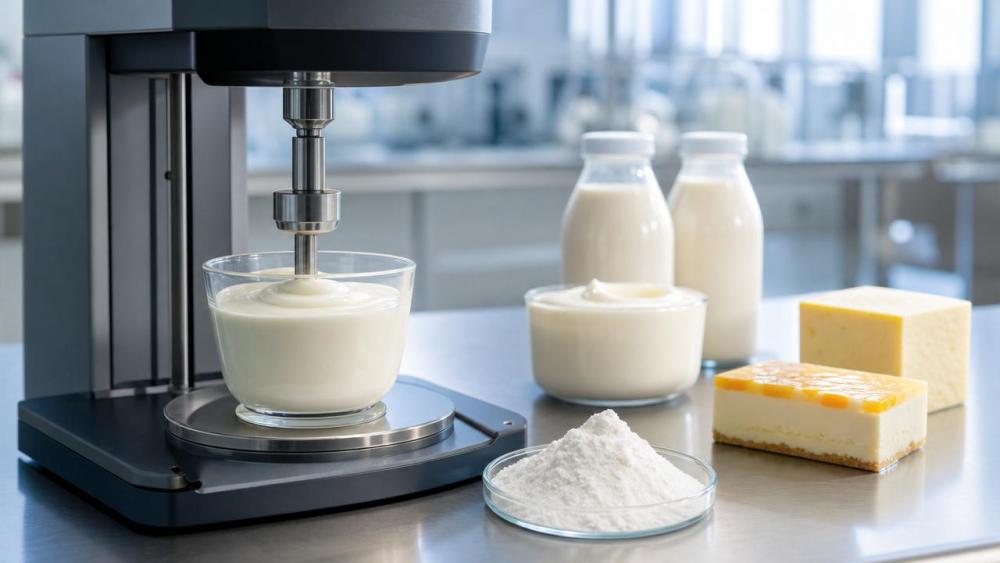
The dairy aisle is moving beyond simple viscosity targets.
Consumers now judge yogurt, cream cheese, desserts, and protein drinks through mouthfeel, spoonability, pourability, and visual stability.
This shift makes rheology modifiers for dairy products central to product identity, not only formulation support.
A stirred yogurt must look glossy, resist whey separation, and feel creamy without being gummy.
A dairy beverage must flow easily, suspend proteins, and remain stable after heat treatment and distribution vibration.
These expectations push dairy formulation toward more precise hydrocolloid selection, protein interaction control, and processing-aware viscosity design.
Trend Signals Reshaping Rheology Modifiers for Dairy Products
Several market signals are changing how rheology modifiers for dairy products are evaluated.
Clean-label demand is rising, but consumers still expect indulgent texture and long shelf life.
High-protein dairy has expanded, creating more risks of sedimentation, chalkiness, gel brittleness, and heat-induced instability.
Reduced-fat formats also need structure-building systems that replace fat lubrication without artificial heaviness.
Meanwhile, global distribution exposes dairy products to wider temperature swings, shear events, and longer storage windows.
The result is a tougher brief for rheological thickeners, stabilizers, and texture systems.
Key Trend Drivers
Why Single-Function Thickening Is Losing Ground
Traditional thickening once focused on reaching a target viscosity number.
That approach is no longer enough for modern dairy products.
Rheology modifiers for dairy products must manage flow, suspension, gel strength, water binding, and sensory release together.
A high Brookfield reading may still produce poor mouthfeel if the system feels sticky or pasty.
Likewise, a low-viscosity drink may remain stable if it has the right yield stress.
This explains the growing use of combined systems, such as pectin with starch or carrageenan with dairy proteins.
The best rheology modifiers for dairy products support texture architecture, rather than simple thickening.
Functional Behaviors That Matter
- Shear thinning for easy pumping, drinking, or spooning.
- Yield stress for particle suspension and reduced whey-off.
- Water binding to limit syneresis during storage.
- Protein compatibility under acidic or neutral pH conditions.
- Heat tolerance during pasteurization, UHT, or retort processing.
- Freeze-thaw resilience for frozen desserts and distributed products.
Ingredient Families Are Moving Toward Smarter Positioning
Different rheology modifiers for dairy products create different technical and sensory signatures.
Selection should begin with product pH, heat process, fat level, protein concentration, and label requirements.
Pectin remains important in acidified milk drinks because it can protect casein particles from aggregation.
Carrageenan is widely used in chocolate milk and neutral dairy drinks for protein stabilization and cocoa suspension.
Xanthan gum offers strong shear-thinning behavior and suspension power at low dosage.
Modified starch supports body, opacity, and cost control, especially in desserts and spoonable dairy.
Gelatin can deliver elastic gel textures, although sourcing and dietary preferences may limit use.
Guar gum and locust bean gum provide viscosity and creamy perception, often in combination with other hydrocolloids.
Practical Selection Snapshot
Processing Conditions Now Decide Texture Success
Even high-quality rheology modifiers for dairy products can fail under unsuitable processing conditions.
Hydration temperature, mixing intensity, order of addition, minerals, and pH adjustment all shape final texture.
Some gums form lumps if dispersed directly into cold aqueous phases without proper premixing.
Some starches need full gelatinization to build body and water control.
Carrageenan performance depends strongly on milk proteins, potassium ions, and heat activation.
Pectin systems need careful pH management to prevent roughness, flocculation, or delayed instability.
This is why lab viscosity data must be connected with real plant conditions.
Processing Risks to Validate Early
- Incomplete hydration causing grainy mouthfeel or weak viscosity.
- Excessive shear breaking fragile gels or starch structure.
- Protein destabilization during acidification or heat treatment.
- Mineral sensitivity changing gel strength across milk sources.
- Post-fill viscosity drift during cooling and storage.
Compliance and Safety Expectations Are Tightening
Texture systems are increasingly reviewed through safety, traceability, and regulatory lenses.
Rheology modifiers for dairy products must meet food-grade specifications, contaminant limits, allergen controls, and regional labeling rules.
Clean-label claims must be supported by accurate ingredient naming and realistic consumer interpretation.
Natural positioning can be weakened if processing aids, carriers, or chemical modification are not clearly understood.
Global products also face different permissions for hydrocolloids, usage levels, and category definitions.
A technically successful stabilizer can still create launch risk if documentation is incomplete.
Documentation Points Worth Checking
- Food-grade certificates and regional regulatory status.
- Microbiological specifications and heavy metal limits.
- Allergen, GMO, halal, kosher, and vegetarian declarations.
- Country-specific additive names and labeling requirements.
- Shelf-life data for the ingredient and finished product.
Business Impact Extends Across the Dairy Value Chain
Better texture control reduces rework, complaints, and batch-to-batch variation.
It also protects brand perception when products face real-world distribution stress.
For dairy innovation, rheology modifiers for dairy products can unlock low-fat, high-protein, indulgent, or plant-dairy hybrid formats.
For production economics, dosage efficiency and process tolerance affect total cost more than ingredient price alone.
For quality systems, stable rheology improves measurable control points, release decisions, and shelf-life confidence.
The impact is therefore operational, sensory, financial, and regulatory at the same time.
What Should Be Prioritized in Future Selection
Future selection of rheology modifiers for dairy products should be based on performance maps, not isolated trials.
The most reliable decisions compare texture behavior across pH, heat, shear, storage, and sensory conditions.
A structured approach prevents over-thickening, excessive stabilizer blends, and hidden process fragility.
Core Evaluation Priorities
- Define target texture by sensory language and measurable rheology.
- Screen compatibility with dairy proteins, minerals, fat, and sweeteners.
- Test thermal stability under actual pasteurization or UHT profiles.
- Validate shear recovery after pumping, homogenization, and filling.
- Confirm stability through shelf-life and distribution simulation.
- Balance clean-label goals with realistic texture performance.
A Practical Roadmap for Smarter Dairy Texture Control
A disciplined roadmap helps turn texture ambition into repeatable dairy quality.
It also keeps rheology modifiers for dairy products aligned with safety, compliance, and sensory expectations.
The Next Competitive Edge Is Evidence-Based Texture Design
Dairy texture control is entering a more scientific and compliance-driven phase.
The strongest formulas will not rely on habit, supplier claims, or single viscosity readings.
They will combine sensory goals, molecular interactions, regulatory clarity, and robust process validation.
This is where rheology modifiers for dairy products become strategic formulation tools.
They help protect consistency, support cleaner labels, and deliver the creamy experiences consumers remember.
For the next formulation review, map each texture issue to pH, protein behavior, heat exposure, and distribution stress.
Then select rheology modifiers for dairy products through controlled trials, documented compliance, and real shelf-life evidence.
That approach turns texture from a corrective task into a measurable competitive advantage.
Related News
- How to assess a bio-based thickener manufacturer's batch consistencyOct 16, 2026Food Rheology Expert
- Verifying halal status of hydrocolloid ingredients in the Middle EastOct 15, 2026Food Rheology Expert
- Why Can Xanthan Gum Lose Viscosity After Adding Electrolytes?Oct 18, 2026Food Rheology Expert
- How Do You Test Hydrocolloid Viscosity After Changing a Thickener?Oct 17, 2026Food Rheology Expert
Related News
- 00
0000-00
2026 Osong Cosmetics and Beauty Expo Concludes in South Korea - 00
0000-00
How to compare cosmetic active compounds by their cost in use - 00
0000-00
HKBU Showcases DR2 Following NMPA Registration as a New Cosmetic Ingredient - 00
0000-00
How to use ingredient market insights to forecast sourcing costs - 00
0000-00
Galderma Marks 30 Years of Hyaluronic Acid Injectable Innovation
Food Rheology Expert
Weekly Insights
Stay ahead with our curated technology reports delivered every Monday.