





On June 18, 2026, the European Food Safety Authority (EFSA) signaled a procedural change with practical trade consequences for xanthan gum (E415): the safety re-evaluation timeline has been pushed back to March 31, 2027, while existing authorization remains in place during the transition. What makes this update worth industry attention is not only the extended review window, but also the new requirement that importers submit complete batch-level heavy metal and endotoxin test reports from December 2026, a shift that directly touches sourcing, import documentation, compliance review, and delivery planning for food and cosmetics supply chains.
What EFSA has formally changed
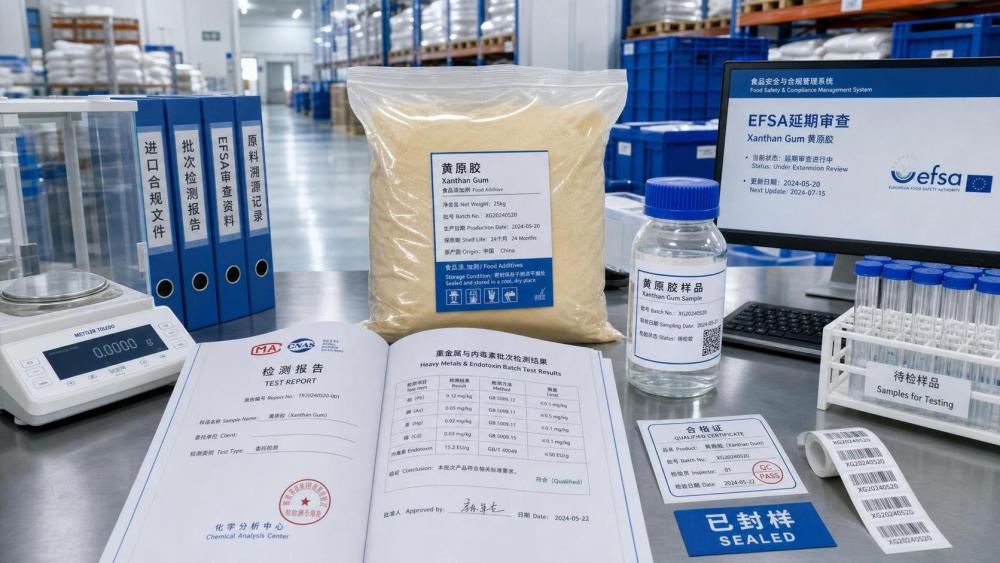
EFSA announced on June 18, 2026 that the deadline for the re-evaluation of xanthan gum (E415) has been moved from the originally scheduled September 2026 date to March 31, 2027 because submission of new toxicological data was delayed. During this extended period, the existing authorization continues to apply. At the same time, all importers will be required, starting in December 2026, to provide complete batch test reports covering heavy metals and endotoxins. The development affects global xanthan gum trade flows and creates a preparation window for European food and cosmetics formulators that rely on supply from China and India.
Where the operational pressure is likely to appear
Import workflows move closer to batch-by-batch compliance
From an industry perspective, importers are among the first parties likely to feel the change because the new reporting expectation applies directly to imported batches. The main impact is likely to fall on shipment documentation, supplier coordination, product release timing, and record readiness. What deserves closer attention is whether existing documentation practices are already capable of supporting complete batch-level heavy metal and endotoxin reporting from December 2026 onward.
Procurement teams gain time, but not less compliance work
For raw material buyers and formulators, the extension to Q1 2027 creates additional time to prepare, but it does not remove the need to align purchasing with the new reporting condition. Analysis shows that procurement planning, supplier qualification review, and material substitution risk assessment may all become more sensitive in the months leading up to December 2026, especially where xanthan gum supply depends on established overseas sources.
Testing and documentation become part of delivery risk
Supply chain service providers, testing-related businesses, and manufacturers using xanthan gum may need to pay closer attention to how test reports are collected, checked, and matched to individual batches. Observably, the pressure point is not only product availability, but whether supporting documents travel with the goods in a form that can satisfy importer-side compliance review. That makes documentation completeness and traceability part of the delivery equation rather than a back-office formality.
Practical points companies should track now
Check whether supplier files support the new importer obligation
Analysis shows that companies purchasing or importing xanthan gum should begin reviewing whether current suppliers can consistently provide complete batch-level heavy metal and endotoxin reports before the December 2026 threshold. The immediate issue is less about changing authorization status and more about whether supporting files can meet the coming documentation standard without disrupting routine imports.
Review contracts, specifications, and release procedures
What deserves closer attention is the wording used in supply agreements, technical specifications, intake checks, and internal release procedures. If batch-level reports become a routine import requirement, businesses may need to make sure document requests, acceptance criteria, and handover timing are reflected clearly in operational paperwork rather than handled informally.
Watch for changes in official wording and market execution
Because the provided information does not include further implementation detail, it is more appropriate to understand the current position as a confirmed compliance direction with elements that still need monitoring in practice. Companies should therefore keep watching for later official wording, execution signals, and any downstream changes in customer document requests or tender materials.
Reassess lead times where overseas sourcing is concentrated
For businesses relying on supply linked to China or India, the preparation window may be useful only if compliance readiness is built into ordering and delivery schedules. Observably, any gap between test reporting readiness and shipment timing could become a practical trade friction point, so procurement and logistics teams should pay attention to document turnaround as well as physical supply continuity.
Why this reads more as an execution signal than a final outcome
Analysis shows that this update should not be read simply as a delay in scientific review. It also signals a nearer-term tightening in importer-side evidence expectations, even while the underlying authorization remains valid during the transition. From an industry perspective, that combination matters because it gives the market more time on one front while raising documentary discipline on another. It is more appropriate to understand this as an execution-stage signal with immediate operational relevance, rather than as a completed regulatory endpoint.
How the market may need to interpret the transition period
The most balanced reading at this stage is that the EFSA announcement creates a defined compliance window rather than a settled market outcome. The extension to March 31, 2027 reduces immediate authorization disruption, but the December 2026 batch-reporting requirement introduces a concrete checkpoint for import operations and supply-chain readiness. For companies active in xanthan gum trade or downstream use, the priority is to treat this as a live compliance preparation issue and continue monitoring how the requirement is reflected in practice.
Basis of this article and what still needs verification
This article is based on the user-provided news title, event date, and event summary. For developments of this type, commonly relevant source categories include official notices, regulator publications, customs or trade authority information, industry association updates, standard-setting documents, and reporting by authoritative media. A specific official source link was not provided in the input, so the exact source document should be further verified. It also remains necessary to keep watching for later detail on implementation language, compliance interpretation, document expectations, tender-file changes, industry feedback, and how companies execute the requirement in practice.
Related News
- How food hydrocolloids prevent ice crystals in frozen dessertsSep 14, 2026Food Rheology Expert
- Which food texture modifiers for sauces prevent thinning after reheating?Sep 13, 2026Food Rheology Expert
- How shear-thinning rheology modifiers balance flow and stabilitySep 07, 2026Food Rheology Expert
- How to choose food thickeners for sauces without changing flavorAug 28, 2026Food Rheology Expert
Related News
- 00
0000-00
How to verify compliance documents for cosmetic active compounds - 00
0000-00
How to verify food grade flavor formulation ingredients for safety - 00
0000-00
How to assess an anti-aging ingredients manufacturer’s batch consistency - 00
0000-00
How formulation tips prevent flavor separation in beverage applications - 00
0000-00
How biodegradable surfactants for laundry affect cold-water cleaning
Food Rheology Expert
Weekly Insights
Stay ahead with our curated technology reports delivered every Monday.