





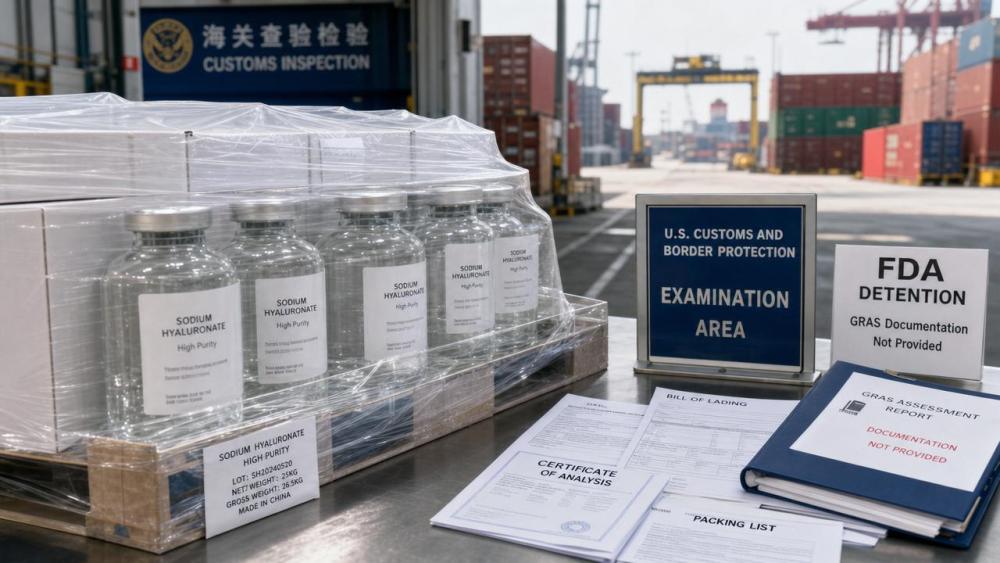
On May 28, 2026, an update from the FDA automatic detention list drew attention to a practical compliance issue for high-purity hyaluronic acid entering the U.S. market. Three China-origin raw material shipments declared as High-purity Hyaluronic Acid were held because complete GRAS Notice numbers or supporting documents for self-determined GRAS status were not provided. For exporters, importers, procurement teams, and downstream users handling high-purity active materials, this development is worth watching because it signals that market access is not only about product specifications, but also about whether identity documentation and safety-positioning documents can be presented together at the point of trade.
What the May detention record clearly shows
The confirmed information is limited but clear. According to the FDA automatic detention list for May 2026, three batches declared as High-purity Hyaluronic Acid from China were held at port. The stated issue was the absence of a complete GRAS Notice number or the supporting basis documents for self-determined GRAS status.
The held goods were concentrated in pharmaceutical-grade HA with molecular weight above 1,500 kDa and purity of at least 95%. Based on the event summary provided, the case highlights a dual compliance threshold in the U.S. market for high-purity active substances: proof of product identity and a safety declaration basis.
Where the pressure may appear across the supply chain
Export filings may face a higher document threshold
From an industry perspective, exporters of high-purity HA may be the first group affected because the detention reason was tied directly to documentation rather than a disclosed issue with shipment quantity or commercial terms. In practice, the immediate pressure point may lie in pre-shipment review of product identity descriptions, GRAS-related references, and the completeness of supporting files submitted or prepared for U.S. entry.
U.S.-bound buyers may need to adjust procurement screening
For procurement teams and importing parties, the impact may extend to supplier onboarding and purchase order review. Analysis shows that buyers handling high-purity HA, especially material described by molecular weight and purity in a more specialized way, may need to pay closer attention to whether suppliers can provide a coherent compliance package rather than only technical quality indicators. What deserves closer attention is whether purchase decisions, delivery scheduling, and supplier substitution plans already take account of possible port delays linked to missing GRAS-related support.
Manufacturing and downstream use may feel the effect through delivery timing
Processors and manufacturers using such raw materials may not be directly named in the detention records, but they may still be affected through delayed inbound supply, revised raw material qualification checks, or additional document requests before release into production. Observably, where a material is positioned as high-purity and active in use, technical acceptance and compliance acceptance may become more tightly linked in commercial execution.
Testing, documentation, and compliance service work may become more front-loaded
Certification-related service providers, testing institutions, and supply chain compliance teams may also see more attention from clients. The issue raised by this event is not simply whether a product can be tested to a specification, but whether identity evidence and safety-basis documents are aligned for the intended market. That may push more work into document preparation, consistency checks, and traceability support before shipment rather than after a hold occurs.
Practical checkpoints companies should watch now
Check whether product identity and market positioning are documented consistently
Analysis shows that one practical focus is the consistency of how high-purity HA is declared across technical documents, trade paperwork, and compliance files. Where the material is described by a higher molecular weight and higher purity profile, companies may need to verify whether the identity description used in export and import documents is fully supported by the associated technical and safety documentation.
Do not treat GRAS references as a secondary attachment
What deserves closer attention is that the detention reason involved missing complete GRAS Notice numbers or the supporting basis for self-determined GRAS status. Based on the provided facts, companies should not assume that product quality documents alone are enough for smooth entry. If a business model relies on GRAS-related positioning, document completeness may need to be reviewed as a core clearance item before shipment.
Build extra time into delivery and purchasing plans for sensitive specifications
For materials falling within the profile mentioned in the event summary, companies may need to watch delivery commitments more carefully. This is not proof of a broader market-wide delay, but it is a reasonable operational observation that procurement plans, customer delivery dates, and replacement sourcing arrangements may need greater flexibility when documentation review becomes a point of enforcement.
Continue tracking any later clarification in enforcement wording
The current information does not provide wider enforcement detail, so it should not be read as a fully defined new rule by itself. Still, companies should monitor whether later official wording, customer document requests, contract terms, or bid specifications place more explicit emphasis on identity confirmation and safety declaration support for similar high-purity active substances.
How this development is best understood at this stage
Observably, this event is more useful as an execution signal than as a standalone policy rewrite. The facts provided do not show a new statute or a newly issued formal rule in themselves, but they do show how existing compliance expectations can surface in trade control through automatic detention. From an industry perspective, the notable point is the pairing of two requirements in actual enforcement attention: the material must be clearly identifiable, and its safety basis for market entry must be documentable.
It is more appropriate to understand this as a sign of stricter practical scrutiny for certain high-purity active materials rather than as a basis for broad conclusions about all HA products. That is why follow-up observation remains important, especially around how customers, import channels, and compliance reviewers translate such cases into routine documentation demands.
Why the case matters beyond the three detained batches
This case matters because it narrows the gap between technical specification management and trade compliance management. Even with limited confirmed facts, the event suggests that for U.S.-bound high-purity HA, specification strength alone may not be enough if the accompanying GRAS-related basis is incomplete. A cautious reading is therefore more suitable: this is a concrete compliance reminder tied to port execution, and its broader significance will depend on whether similar document expectations continue to appear in later practice.
Basis of this article and what still needs verification
This article is generated based on the user-provided news title, event date, and event summary. The available factual basis is the reported May 2026 FDA automatic detention list entry concerning three China-origin High-purity Hyaluronic Acid shipments and the stated GRAS-document gap.
For this type of event, commonly relevant source categories may include official regulatory releases, regulator-maintained detention or enforcement records, customs or trade administration information, industry association updates, standards documents, and reporting by authoritative media. A specific official source link was not provided in the input, so the exact original reference still needs to be verified on an ongoing basis.
Further observation is still needed on any later policy detail, enforcement interpretation, certification-related practice, customer document requirements, bid document changes, industry feedback, and how affected companies adjust execution in response.
Related News
- Galderma Marks 30 Years of Hyaluronic Acid Injectable InnovationOct 24, 2026Cosmeceutical Formulator
- Sihuan Pharmaceutical’s Two Self-Developed Aesthetic Products Approved in Hong KongOct 21, 2026Cosmeceutical Formulator
- Does Low-Molecular-Weight Hyaluronic Acid Work Better in Leave-Ons?Oct 23, 2026Cosmeceutical Formulator
- How high purity actives for serums reduce formula instability riskSep 30, 2026Cosmeceutical Formulator
Related News
- 00
0000-00
2026 Osong Cosmetics and Beauty Expo Concludes in South Korea - 00
0000-00
How to compare cosmetic active compounds by their cost in use - 00
0000-00
HKBU Showcases DR2 Following NMPA Registration as a New Cosmetic Ingredient - 00
0000-00
How to use ingredient market insights to forecast sourcing costs - 00
0000-00
Galderma Marks 30 Years of Hyaluronic Acid Injectable Innovation
Cosmeceutical Formulator
Weekly Insights
Stay ahead with our curated technology reports delivered every Monday.