





Water-soluble flavors must deliver consistent aroma, clarity, and stability during real-world processing, yet lipophilic compounds often resist easy dispersion in aqueous systems.
This challenge affects mixing efficiency, sensory performance, shelf life, and batch-to-batch quality across beverages, dairy, confectionery, nutrition, and personal care applications.
Understanding lipophilic compounds helps formulation teams select better emulsifiers, carriers, processing conditions, and quality controls for reliable taste experiences.
What Are Lipophilic Compounds in Water-Soluble Flavors?
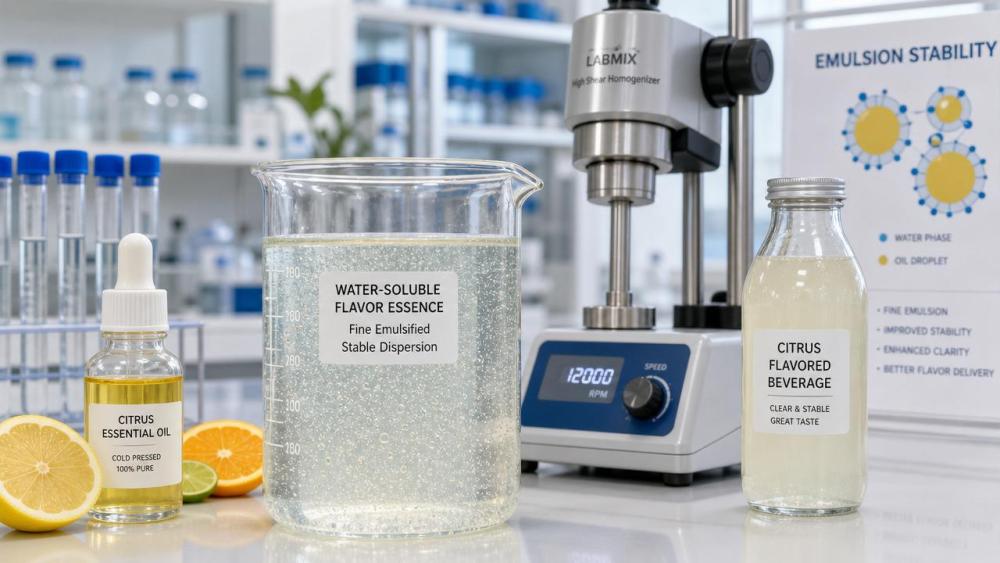
Lipophilic compounds are oil-loving molecules with limited affinity for water. In flavor systems, many aroma chemicals naturally fall into this category.
Citrus terpenes, esters, aldehydes, lactones, essential oil fractions, and some botanical extracts can behave as lipophilic compounds.
They often contribute freshness, creaminess, fruitiness, floral notes, roasted nuances, or long-lasting top-to-base aroma transitions.
The difficulty is simple: water-based products need clarity and uniformity, while lipophilic compounds prefer oil phases or hydrophobic microenvironments.
Without proper design, these molecules may float, ring, haze, separate, oxidize, or adhere to packaging surfaces.
A water-soluble flavor is not always a truly molecular solution. It may be a solubilized, emulsified, encapsulated, or carrier-assisted system.
That distinction matters because lipophilic compounds respond differently to pH, sugar, alcohol, proteins, salts, heat, and shear.
Why does this matter for sensory design?
Aroma perception depends on release timing, volatility, matrix binding, and retronasal delivery during consumption.
Lipophilic compounds may deliver high impact, but their release can be delayed, suppressed, or uneven in aqueous formats.
For example, orange oil components create authentic peel notes, yet unstable dispersion may cause surface oiling and flavor loss.
In dairy beverages, fat, protein, and emulsifiers can trap lipophilic compounds, changing perceived intensity over shelf life.
Why Do Lipophilic Compounds Create Stability Problems?
The main issue is thermodynamic incompatibility. Water molecules form strong hydrogen-bond networks that exclude nonpolar flavor molecules.
Lipophilic compounds therefore seek each other, forming droplets, films, or concentrated zones when no stabilizing system exists.
This behavior can appear as turbidity, creaming, sediment interaction, visible rings, or inconsistent headspace aroma.
Processing can intensify the problem. Heat increases volatility, oxygen accelerates oxidation, and inadequate shear creates broad droplet-size distribution.
During storage, lipophilic compounds can migrate into caps, labels, liners, or plastic bottles, reducing flavor strength.
Some molecules also react with acids, preservatives, proteins, or reducing sugars, producing off-notes or lower aroma freshness.
Common instability signals
- Loss of top notes after hot filling or pasteurization.
- Oil droplets or neck rings in clear beverages.
- Cloud growth during accelerated temperature storage.
- Flavor imbalance between first production and later batches.
- Aroma scalping into PET, HDPE, or closure materials.
When lipophilic compounds are poorly stabilized, quality problems rarely stay isolated. Appearance, aroma, compliance, and cost can all be affected.
How Can Lipophilic Compounds Be Made Compatible with Water?
Compatibility depends on creating a stable bridge between water and hydrophobic aroma molecules.
This bridge may come from emulsifiers, solubilizers, hydrocolloids, modified starches, cyclodextrins, gum arabic, proteins, or encapsulation matrices.
The best option depends on clarity goals, label strategy, processing temperature, pH, flavor load, cost, and regulatory status.
Solubilization for clear systems
Solubilizers arrange into micelles that hide lipophilic compounds inside hydrophobic cores while presenting hydrophilic surfaces to water.
This route suits clear beverages, functional waters, syrups, and low-dose aroma applications.
However, excessive solubilizer can suppress aroma release, create foam, alter mouthfeel, or raise clean-label concerns.
Emulsification for stronger flavor loads
Emulsions disperse lipophilic compounds as fine droplets protected by interfacial films.
They are useful for citrus flavors, beverage clouds, dairy flavors, sauces, and products where slight opacity is acceptable.
High-pressure homogenization, rotor-stator mixing, and correct emulsifier selection strongly influence droplet stability.
Encapsulation for process protection
Encapsulation locks lipophilic compounds inside carbohydrate, protein, or polymeric matrices.
Spray-dried flavors, beadlets, and powder premixes benefit from better oxidation control and easier handling.
Release must be designed carefully, especially in instant beverages, baked goods, gummies, and nutritional powders.
Which Applications Are Most Sensitive to Lipophilic Compounds?
Sensitivity rises when products demand clarity, long shelf life, delicate aroma balance, or aggressive processing.
In clear beverages, small amounts of unstable lipophilic compounds can create visible haze or rings.
In carbonated drinks, pressure, acidity, and carbonation affect aroma lift and droplet behavior.
In dairy systems, proteins and fat phases can either protect or trap lipophilic compounds.
In confectionery, sugar solids, acids, gels, and heating steps change flavor release and retention.
In oral care, lipophilic compounds must coexist with surfactants, humectants, abrasives, and strong mint oils.
In cosmetics and personal care, fragrance oils face similar challenges in aqueous gels, lotions, and rinse-off products.
Application-by-application priorities
This comparison shows why lipophilic compounds should be evaluated within the final matrix, not only in water.
How Should Formulas Be Evaluated Before Scale-Up?
A bench sample can look stable for one day and fail after transport, heating, freezing, or warehouse storage.
Evaluation should therefore combine physical testing, sensory checks, analytical data, and packaging compatibility.
For lipophilic compounds, droplet size distribution is one of the most useful early indicators.
Smaller, uniform droplets usually improve stability, though excessive emulsifier may dull aroma release.
Turbidity, centrifugation, thermal cycling, freeze-thaw testing, and accelerated aging help reveal hidden instability.
Gas chromatography can track key aroma markers and reveal losses from oxidation, reaction, or packaging absorption.
Recommended evaluation checklist
- Confirm regulatory status of flavor carriers, emulsifiers, and processing aids.
- Measure clarity or turbidity after production and after storage.
- Check aroma strength at initial, mid-point, and end-of-life stages.
- Test pH, heat, salt, alcohol, and preservative compatibility.
- Compare glass, PET, aluminum, and closure interactions.
- Run pilot production before approving commercial parameters.
Testing should reflect the worst credible conditions, not only ideal laboratory storage.
Lipophilic compounds are especially vulnerable when oxygen exposure, light, and high temperature occur together.
What Mistakes Commonly Lead to Flavor Failure?
One common mistake is treating water solubility as a fixed property rather than a system-dependent outcome.
Lipophilic compounds may appear soluble in a concentrate, yet fail after dilution into the final product.
Another mistake is increasing emulsifier blindly when instability appears.
More emulsifier can improve appearance while weakening aroma lift, adding bitterness, or affecting foam.
Ignoring processing sequence is also risky. Adding lipophilic compounds before hydration, acidification, or heating can change dispersion quality.
Incorrect carrier choice can create sediment, cloud, or off-notes, especially in acidic and mineral-rich drinks.
Risk and prevention table
These failures are preventable when lipophilic compounds are considered from molecular design through commercial handling.
How Can Teams Choose the Right Solution for Lipophilic Compounds?
Selection starts with the final product target. Clarity, taste intensity, label claim, cost, and shelf life must be ranked early.
For transparent drinks, solubilized systems are usually preferred, but sensory release must be confirmed.
For cloudy or creamy products, emulsions may support higher flavor loads and stronger mouthfeel integration.
For powders and heat-exposed foods, encapsulated lipophilic compounds can improve handling, storage, and controlled release.
Clean-label strategies may favor gum arabic, modified starch alternatives, plant proteins, or naturally derived emulsifiers.
However, natural positioning should not replace stability data. Some natural systems need tighter processing control.
Decision framework
- Define whether the product must be clear, translucent, cloudy, or opaque.
- Map all stress points, including heat, acid, pressure, light, and transport.
- Identify which lipophilic compounds drive key aroma character.
- Select a carrier system aligned with regulation and label goals.
- Validate sensory release, not only physical stability.
- Confirm performance in final packaging and commercial dilution.
A good solution balances molecular compatibility with business realities, including supply stability, dosing convenience, and premium sensory positioning.
FAQ Summary: Practical Answers About Lipophilic Compounds
These answers provide a practical starting point, but every formula needs matrix-specific validation.
Conclusion: Turning Molecular Complexity into Reliable Flavor
Lipophilic compounds are not obstacles by default. They are powerful sensory tools when managed through intelligent formulation.
Their behavior explains many common problems in water-soluble flavors, including haze, oiling, aroma loss, and shelf-life variation.
The best results come from matching molecule, carrier, process, packaging, and application environment.
For new launches or reformulations, begin with a structured review of flavor chemistry, processing stress, and final matrix behavior.
Then compare solubilization, emulsification, and encapsulation through real storage and sensory testing.
With disciplined evaluation, lipophilic compounds can support cleaner aroma, better consistency, stronger differentiation, and safer global FMCG execution.
Related News
- When heat stable flavor formulations are needed for UHT beveragesOct 04, 2026Aromatics & Perfumery Fellow
- How heat stable flavor formulations prevent aroma loss in baked goodsOct 03, 2026Aromatics & Perfumery Fellow
- Using 4-vinyl guaiacol flavour standard to calibrate sensory panelsOct 02, 2026Aromatics & Perfumery Fellow
- Garlic Powder Flavor Profiles and Their Role in Seasoning BlendsSep 28, 2026Aromatics & Perfumery Fellow
Related News
- 00
0000-00
Bairun Nine-Month Profit Up 20.4% to RMB 662m; Flavors and Fragrances Also Grow - 00
0000-00
How biomimetic peptides work in anti-aging skincare formulations - 00
0000-00
2026 Osong Cosmetics and Beauty Expo Concludes in South Korea - 00
0000-00
How to compare cosmetic active compounds by their cost in use - 00
0000-00
HKBU Showcases DR2 Following NMPA Registration as a New Cosmetic Ingredient
Aromatics & Perfumery Fellow
Weekly Insights
Stay ahead with our curated technology reports delivered every Monday.