





Hydrocolloids shape product experience in ways that consumers notice immediately, even when they never see the ingredient list. In foods, personal care, and other FMCG applications, they influence body, flow, suspension, moisture control, and storage performance.
That is why hydrocolloids matter far beyond simple thickening. They sit at the intersection of sensory design, processing stability, clean-label strategy, and shelf-life management, making them a recurring point of attention across the ingredient intelligence landscape followed by FFAI.
Why hydrocolloids remain central to formulation decisions
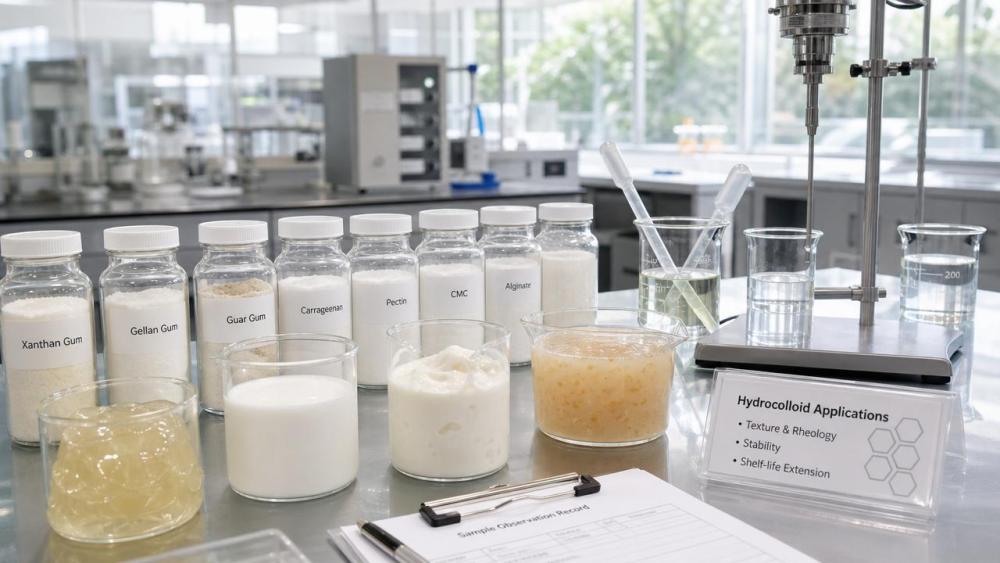
At a basic level, hydrocolloids are water-loving polymers that hydrate, swell, or form networks in liquid systems. Depending on type and dosage, they can thicken, gel, stabilize emulsions, suspend particles, reduce syneresis, or improve freeze-thaw behavior.
Simple descriptions can be misleading, though. Two products may both contain hydrocolloids, yet one delivers creamy spoonability while another prevents sedimentation in a beverage or keeps a cosmetic serum from separating.
This functional range explains their strategic value. In the FFAI view of ingredient systems, hydrocolloids are not isolated additives. They interact with preservatives, pigments, flavors, actives, and surfactants, often determining whether a formula performs consistently from production line to end use.
Texture is usually the first visible effect
Texture is where hydrocolloids become commercially visible. A yogurt that feels silky, a sauce that coats evenly, or an ice cream that melts slowly often depends on carefully chosen rheological control.
Xanthan gum is a familiar example because it delivers viscosity at low use levels and performs well under shear. Guar gum, carrageenan, pectin, alginate, locust bean gum, and cellulose derivatives each create different sensory signatures.
That difference matters in formulation work. A thicker product is not automatically a better product. The target may be short texture, elastic gel strength, pourability, cling, spreadability, or a clean break on the spoon.
In practical terms, hydrocolloids help translate abstract product positioning into measurable physical behavior. Premium perception often starts with mouthfeel, and mouthfeel often starts with the right hydrocolloid system.
Texture goals often differ by category
- Dairy and plant-based products often need creaminess, suspension, and reduced phase separation.
- Bakery fillings and sauces usually require controlled flow and water retention.
- Confectionery systems may depend on gel strength, bite, and shape retention.
- Cosmetic emulsions often focus on glide, cushion, and elegant skin feel.
Stability is where hydrocolloids protect performance over time
A freshly made formula can look excellent on day one and fail by week four. Stability is the longer test, and hydrocolloids are often part of the answer because they manage movement inside the system.
By increasing viscosity or building a weak gel network, hydrocolloids slow down separation, creaming, sedimentation, and water migration. In emulsified products, they also support the continuous phase, helping dispersed droplets remain uniformly distributed.
This is especially relevant in global supply chains. Products may face temperature swings, vibration, long storage periods, and repeated handling. Stability that looks sufficient in the lab may collapse during transport if the hydrocolloid system is poorly matched.
FFAI’s broader ingredient perspective makes this point important. A flavor profile, active compound, or pigment can only create value when the surrounding matrix keeps the formula intact and usable.
Shelf life is not only about preservatives
Shelf life is often discussed through oxidation control or antimicrobial protection, yet physical deterioration can shorten commercial life just as quickly. Hydrocolloids support shelf life by preserving acceptable texture and appearance over time.
For example, moisture migration in baked goods can harden one layer while softening another. In frozen desserts, ice crystal growth can damage smoothness. In beverages, suspended particles may settle before the stated shelf window ends.
Hydrocolloids do not replace preservatives, but they complement them. In many systems, the best shelf-life outcome comes from combined design: antioxidant protection, microbial control, correct packaging, and rheology management working together.
That systems view fits well with FFAI’s coverage of preservation, thickeners, and sensory materials. Shelf life is rarely solved by one ingredient alone; it is built through compatible ingredient architecture.
Where hydrocolloids create value across sectors
Food remains the clearest application area, but hydrocolloids are relevant across the wider consumer products economy. Their value changes with the matrix, yet the decision logic is similar: target texture, process tolerance, ingredient compatibility, and storage behavior.
In beverages, hydrocolloids can keep insoluble components evenly dispersed while maintaining drinkability. In sauces and dressings, they influence cling and suspension. In dairy and plant-based alternatives, they help balance creaminess with protein stability.
In cosmetics, hydrocolloids contribute to serum body, gel clarity, mask adhesion, and sensory elegance around expensive actives. In household products, they may improve flow control, deposition, or visual consistency in surfactant-rich systems.
This cross-sector relevance explains why hydrocolloids attract sustained attention in formulation intelligence. They are practical tools for solving physical problems while also shaping premium sensory outcomes.
Current market signals worth watching
- Clean-label pressure is increasing demand for recognizable or naturally sourced hydrocolloids.
- Plant-based products need better texture systems to offset protein and fat differences.
- Premium beauty products use refined rheology as part of sensorial differentiation.
- Global distribution increases the importance of transport and storage resilience.
How to judge hydrocolloids in real formulation work
Selecting hydrocolloids by name alone is risky. The better approach is to begin with the failure mode that must be prevented and the sensory result that must be achieved.
One formulation may need cold-process hydration, while another must survive heat, acid, salt, or high shear. Some hydrocolloids perform well individually. Others work best in blends that create synergy, as seen in certain gum combinations.
Regulatory and label considerations also matter. A technically effective option may create friction if the declaration is poorly aligned with market positioning, export requirements, or regional acceptance.
For that reason, useful evaluation should include both lab data and market context. FFAI’s intelligence model reflects this balance by linking molecular behavior, compliance realities, and commercial value formation.
- Define the target sensory profile before screening ingredients.
- Test performance under real processing and storage conditions.
- Check interactions with proteins, acids, salts, oils, and actives.
- Review label fit, regional rules, and supply consistency.
- Compare total system value, not only cost per kilogram.
A practical next step for better decisions
Hydrocolloids affect far more than viscosity. They shape how products feel, how they survive distribution, and how long they remain acceptable in the market. That makes them essential to both formulation performance and business credibility.
A useful next step is to map each hydrocolloid question against a specific product goal: texture correction, separation control, shelf-life extension, clean-label alignment, or sensory premiumization. That framework makes comparisons sharper and trial work more productive.
When the category is moving quickly, the strongest decisions usually come from combining technical trials with ingredient intelligence on regulation, market signals, and application fit. That is where hydrocolloids become less of a commodity and more of a strategic formulation lever.
Related News
- Which food texture modifiers for sauces prevent thinning after reheating?Sep 13, 2026Food Rheology Expert
- How shear-thinning rheology modifiers balance flow and stabilitySep 07, 2026Food Rheology Expert
- How to choose food thickeners for sauces without changing flavorAug 28, 2026Food Rheology Expert
- How to Choose Xanthan Gum Solutions for Stable Viscosity in Food FormulationsAug 13, 2026Food Rheology Expert
Related News
- 00
0000-00
Which food texture modifiers for sauces prevent thinning after reheating? - 00
0000-00
How to verify supplier references for active compounds - 00
0000-00
How functional additives for beverages affect shelf-life stability - 00
0000-00
How to verify clean label ingredients for Europe meet label claims - 00
0000-00
What drives Pro-Xylane price differences between cosmetic suppliers?
Food Rheology Expert
Weekly Insights
Stay ahead with our curated technology reports delivered every Monday.