





In 2026, the cost of FMCG ingredients is shaped by far more than crop yields or petrochemical benchmarks. Pricing now reflects energy exposure, compliance burden, reformulation pressure, biotech scaling, logistics resilience, and the premium attached to proven efficacy. For brands operating across food, fragrance, beauty, and home care, that shift changes how margins are protected and how ingredient portfolios should be built.
Why ingredient cost has become a strategic issue
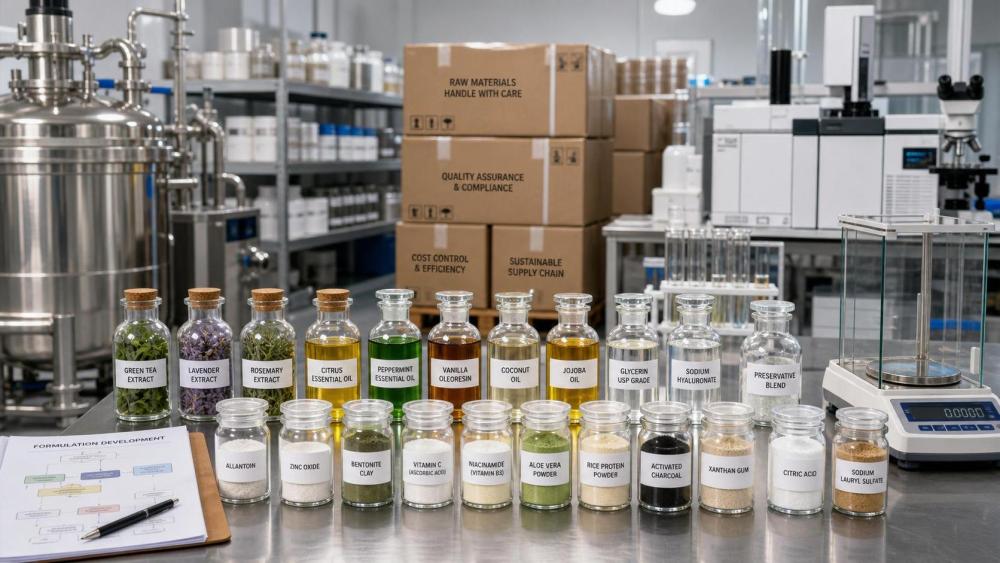
FMCG ingredients sit at the intersection of chemistry, regulation, manufacturing, and consumer perception. A small change in an antioxidant, thickener, fragrance molecule, peptide, or surfactant can alter cost structures across the full product lifecycle.
This matters because ingredient inflation no longer behaves evenly. A preservative may face compliance-driven price pressure, while a fragrance component may spike because of crop failure, solvent costs, or restricted sourcing regions.
At the same time, clean-label expectations and scientific claims are pulling formulas in opposite directions. One side wants simplicity and naturality. The other wants stronger performance, longer shelf life, and measurable results.
That tension is especially visible in the areas tracked by FFAI, where sensory chemistry and active efficacy directly affect brand positioning. In other words, ingredient cost is no longer a back-office issue. It is a market strategy issue.
The main cost drivers behind FMCG ingredients in 2026
Several forces are moving together, and their combined effect is more important than any single input price.
Energy and process intensity
Many FMCG ingredients require controlled heating, extraction, purification, drying, or fermentation. Energy costs therefore affect more than factories. They influence yield stability, batch consistency, and final ingredient quality.
This is particularly relevant for high-purity cosmetic actives, essential oil fractions, and specialty hydrocolloids, where process conditions are not easily simplified without sacrificing performance.
Regulatory compliance and documentation
Compliance is becoming a direct cost driver. FDA GRAS work, European cosmetics notification, toxicology files, traceability systems, and export documentation all add measurable cost to qualified supply.
More importantly, compliant suppliers often carry pricing power. When standards tighten, low-cost alternatives can disappear quickly, leaving only validated sources in the market.
Clean-label reformulation
Replacing synthetic systems with natural pigments, botanical extracts, or milder preservation approaches often raises formulation complexity. The ingredient line may look cleaner, but the surrounding formulation work becomes more expensive.
A simple substitution rarely works on its own. Texture, color stability, oxidation resistance, and microbial control usually need to be rebuilt together.
Biotech innovation and scale economics
Biotech-derived peptides, recombinant collagen systems, precision-fermented aroma compounds, and advanced surfactants promise better performance. Yet their economics depend heavily on scale, licensing, and process maturity.
Early adoption can create differentiation, but it often comes with a cost premium that only makes sense when claims, margin, and brand tier are aligned.
Supply chain resilience
Lead time reliability has become part of ingredient cost. Dual sourcing, buffer inventory, regional warehousing, and alternate origins all increase carrying cost, yet they reduce the far greater risk of production interruption.
For FMCG ingredients linked to climate-sensitive crops or geopolitically exposed feedstocks, resilience spending is often cheaper than emergency reformulation.
Cost pressure looks different across ingredient categories
The broad market headline can hide very different realities. FFAI’s five focus pillars show why category-level reading matters.
The practical lesson is straightforward. FMCG ingredients should not be compared only by price per kilogram. They should be compared by performance per formula, compliance security, and impact on finished-goods pricing.
Where the margin risk usually hides
The visible invoice price is only one layer of cost. Margin erosion often comes from secondary effects that appear later in development or commercialization.
- A cheaper preservative system may shorten shelf life and increase returns.
- A lower-cost thickener may weaken mouthfeel and reduce repeat purchase.
- A fragrance substitution may alter top-note perception and dilute brand recognition.
- An active with weak substantiation may trigger claim revisions and relaunch expense.
- A single-source surfactant may create downtime if shipping routes tighten.
That is why the most useful cost view combines procurement data with formulation, compliance, and commercial outcomes. FFAI’s market lens is valuable here because ingredient economics often start at the molecular level and end at retail perception.
How to interpret cost signals in real business scenarios
A 2026 sourcing decision should ask not only what an ingredient costs today, but also what it enables or restricts over the next product cycle.
Food and beverage systems
For food applications, the interaction between preservatives, antioxidants, pigments, and thickeners is crucial. Paying more for a stable system may protect distribution range, waste reduction, and label credibility.
Fragrance and sensory categories
In fragrance-led products, consumers often notice inconsistency faster than inflation. Cost management therefore depends on maintaining olfactory identity while balancing naturals, synthetics, and regional sourcing options.
Beauty and personal care
For serums, creams, shampoos, and cleansers, the burden of proof matters. Premium FMCG ingredients can support higher end-market pricing, but only when penetration, safety, and sensory elegance are technically defensible.
This is where intelligence becomes more useful than short-term bargain hunting. Understanding how a peptide survives formulation stress, or how an amino acid surfactant changes scalp feel, can prevent false savings.
A workable framework for 2026 ingredient decisions
Instead of chasing the lowest immediate quote, it is more effective to evaluate FMCG ingredients through a compact decision framework.
- Map ingredient cost to finished-product claim value, not only to formulation cost.
- Separate volatile commodities from strategic specialty ingredients.
- Test substitution risk before changing sensory or efficacy-critical inputs.
- Review compliance files as part of sourcing, not after vendor selection.
- Track total delivered cost, including lead time, quality deviation, and reformulation workload.
- Use market intelligence to compare ingredient premiums against retail price elasticity.
This approach is especially relevant for companies balancing clean labels, anti-aging science, and sensory differentiation. Those priorities can coexist, but only when ingredient economics are read in context.
What deserves attention next
The next wave of cost movement will likely come from stricter sustainability expectations, regional compliance divergence, and further adoption of high-purity biotech ingredients. Each of those trends will reward better data discipline.
For that reason, the most resilient organizations will keep revisiting their FMCG ingredients mix by category, claim, origin, and technical dependency. Not every premium is worth paying. Some are essential.
A useful next step is to review current formulations against three questions: which ingredients truly create differentiation, which ones quietly carry compliance risk, and which ones should be sourced with deeper market intelligence before the next negotiation cycle.
Related News
- How to verify supplier references for active compoundsSep 12, 2026Prof. Elian Thorne
- How to evaluate the odor impact of sensory ingredients for perfumesSep 01, 2026Prof. Elian Thorne
- How to build a procurement plan that reduces food ingredient stockoutsAug 29, 2026Prof. Elian Thorne
- How functional additives for skincare affect texture stability in emulsionsAug 22, 2026Prof. Elian Thorne
Related News
- 00
0000-00
How biodegradable surfactants for laundry affect cold-water cleaning - 00
0000-00
How food hydrocolloids prevent ice crystals in frozen desserts - 00
0000-00
Which food texture modifiers for sauces prevent thinning after reheating? - 00
0000-00
How to verify supplier references for active compounds - 00
0000-00
How functional additives for beverages affect shelf-life stability
Prof. Elian Thorne
Weekly Insights
Stay ahead with our curated technology reports delivered every Monday.